Senegal
The westernmost tip of Africa, a Sahel country facing the Atlantic, famous for its hospitality and its music.
French official
At a glance
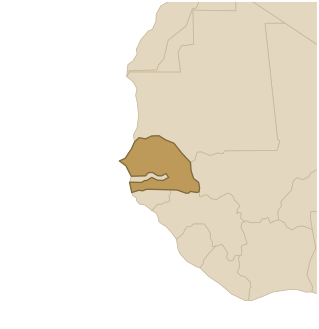
Senegal occupies the westernmost tip of the African continent, where the land reaches furthest into the Atlantic. It is a flat, hot Sahel country, where desert meets savanna. About 18 million people live there, many around the capital, Dakar, on its peninsula. Senegal has a special reputation in Africa: as a stable country that has seen several peaceful transfers of power, and for its hospitality raised to a value, teranga.
Geography
The country is low and open, without much relief. In the north and east lies the dry Sahel, where the Senegal River forms a lifeline of a border with Mauritania. Further south the savanna grows greener and wetter, down to Casamance, a lush region of rice fields and forests. The long Atlantic coast, lined with beaches and fishing villages full of brightly painted pirogues, keeps the country going. Off Dakar lies the island of Gorée, a symbol of the memory of the slave trade.
Peoples and history
Senegal long lay on the edges of the great Sahel empires (Ghana, Mali, Songhai), from which it received Islam and trade, before its own kingdoms arose, such as Jolof. On the coast, Europeans set up trading posts very early, and the island of Gorée has become a symbol of the Atlantic slave trade. France made Saint-Louis, then Dakar, the capital of its West African empire. At independence in 1960 the country's president was Léopold Sédar Senghor, poet and thinker of négritude, who became the first African elected to the Académie française.
Peoples, languages and faith
Senegal is home to many peoples: the Wolof, the largest group, Fulani herders, the Serer, the Diola of Casamance and the Toucouleur. Wolof is the common language for almost everyone, while French remains the official language. The country is overwhelmingly Muslim, with an Islam deeply shaped by the great Sufi brotherhoods, the Mourides and the Tijanis, whose spiritual leaders are highly respected; the holy city of Touba is the heart of the Mouride brotherhood. A Christian minority lives alongside them on good terms.
Culture and way of life
Senegal is one of Africa's great musical centres: mbalax, a driving rhythm carried around the world by the voice of Youssou N'Dour, was born here. The tradition of the griots, storytellers and musicians, is still alive. At the table everyone gathers around the national dish, thieboudienne, rice with fish and vegetables shared from a large common platter and on UNESCO's intangible heritage list. It is also the land of traditional wrestling, the national sport, followed with passion, and of elegant, colourful boubous.