Singapore
An island city-state at the tip of Southeast Asia, a global shipping crossroads that grew rich out of a mix of peoples.
city-state
At a glance
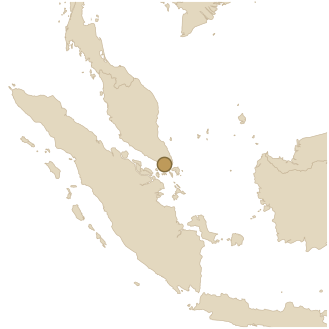
Singapore is an island city-state, one of the smallest countries in the world by area, at the southern tip of the Malay peninsula, where Asia's great shipping routes meet. About six million people live there, in one of the densest, richest and most modern cities on Earth. Independent for sixty years and without natural resources, Singapore has risen through trade, its port and its organisation to become one of the most prosperous countries in the world, while bringing together the Chinese, Malay and Indian worlds.
Geography
Singapore is one main island surrounded by some sixty islets, just north of the equator, hot and humid all year. Almost nothing is left of the original jungle, but the city has set out to be a "garden city": skyscrapers covered in plants, parks and gardens such as Gardens by the Bay with its "supertrees". Short of land, the country has grown by about a quarter by reclaiming land from the sea. It is a landscape shaped entirely by people, where futuristic urban planning sits alongside carefully protected pockets of nature.
History
Once a Malay trading post, the island was re-founded in 1819 by the Briton Stamford Raffles as a free port of the Empire, which immediately drew waves of Chinese, Indian and Malay migrants who came to trade and work: the origin of its multicultural population. A prosperous stop on the route to Asia, Singapore suffered a harsh Japanese occupation during the war. In 1965, in a unique case, it was expelled from the Malaysian federation and became independent against its will, tiny and without resources. Under Lee Kuan Yew it became, within a generation, one of the most developed countries in the world, at the cost of tightly controlled political freedoms.
Languages and faith
Singapore has four official languages, reflecting its peoples: English (the common language and the language of business), Mandarin, Malay (the national language) and Tamil. On the street, everyone gets by in a local English, Singlish. The state has made religious harmony a founding principle: Buddhism, Taoism, Islam, Christianity and Hinduism live side by side, temples, mosques and churches stand in the same neighbourhoods, and each community's festivals are celebrated by the whole nation.
Culture and way of life
Singapore's culture comes from a rare mix, visible in its neighbourhoods: Chinatown, Little India and the Malay quarter of Kampong Glam. The heart of daily life is food: in the hawker centres, halls of cheap food stalls whose culture is on UNESCO's intangible heritage list, you find Hainanese chicken rice, laksa, Indian curry, Malay satay and chilli crab, all for a few coins. Eating is a national passion. Add to that futuristic architecture and a famous sense of cleanliness and order.