Svalbard
A Norwegian archipelago in the far north, one of the northernmost inhabited places in the world, a realm of polar bears, glaciers and polar night, halfway to the Pole.
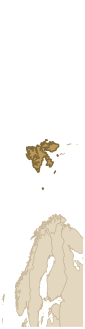
with Jan Mayen
+ Russian, English
At a glance
Svalbard is a Norwegian archipelago in the Arctic Ocean, halfway between mainland Norway and the North Pole, one of the northernmost inhabited places on Earth. This Norwegian territory has a unique international status, set by a treaty that lets citizens of many countries live and work there without a visa. A few thousand people live there, mostly in Longyearbyen, the northernmost settlement in the world with more than a thousand inhabitants, in an international community of Norwegians, Russians, scientists and people from all over. Svalbard has never had an Indigenous population. A realm of polar bears and glaciers, it is a world of ice, coal and science.
Geography
Svalbard is a world of ice and rock. Glaciers cover nearly two-thirds of the archipelago, flowing from jagged peaks down to deep fjords. The Arctic tundra, free of snow in summer, then grows a low, fragile carpet of plants. Wildlife rules: polar bears, roughly as many in the region as there are people, Svalbard reindeer, Arctic foxes, walruses and seabirds by the thousand. The polar climate brings a long polar night in winter, when the sun does not rise for months and the northern lights appear, and an unbroken midnight sun in summer.
History
Found uninhabited by the Dutch navigator Willem Barentsz in 1596, the archipelago became a major centre of whaling and walrus hunting, where Dutch, English, Russian and Scandinavian sailors met. The 20th century brought the age of coal: Norwegian and Russian companies opened mines and founded mining towns, including Longyearbyen. In 1920 the Svalbard Treaty recognised Norwegian sovereignty while guaranteeing all signatory countries a right of access and economic activity. Today coal is in decline and Svalbard is turning to scientific research (climate, the Arctic) and tourism; it is also home to the Global Seed Vault, which stores seeds of crops from around the world.
Language and faith
Svalbard's language is Norwegian, but its very international population also speaks Russian (in the Russian mining settlement of Barentsburg), English and many other languages. The archipelago is Christian by tradition, mainly Lutheran like Norway, and the church in Longyearbyen, one of the northernmost in the world, is a meeting place for the community. Above all, though, Svalbard is a secular, cosmopolitan society, where belonging to the small community often counts for more than origin or religion.
Culture and way of life
Svalbard's culture is that of an international, frontier community shaped by the Arctic, mining and science. Life is built on solidarity in an extreme environment: nobody leaves town without a rifle, as a precaution against polar bears, and people take their shoes off when entering homes and many public buildings, a custom from the mining days. It is a world of sled dogs and snowmobiles, of watching the northern lights and the wildlife, and of shared life through the polar night. The food mixes reindeer, fish and flavours brought by residents from all over the world.