Solomon Islands
An archipelago of forests and lagoons in the heart of Melanesia, home to some of the oldest peoples of the Pacific and scene of great battles, where dozens of languages are spoken.
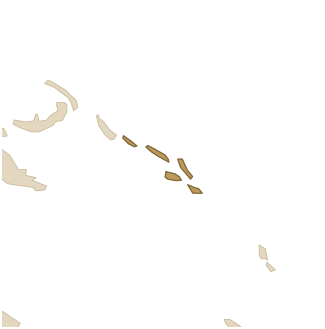
+ English, ~70 languages
At a glance
Solomon Islands is an archipelago in the South Pacific, in the heart of Melanesia, east of Papua New Guinea: nearly a thousand islands, six of them large, mountainous and forested. About 740,000 people live there; the capital, Honiara, is on Guadalcanal, a name that went down in history. Its human diversity is remarkable: nearly seventy languages are spoken. Settled very early and still largely rural, the country lives mainly from the land, the sea and custom.
Geography
The archipelago is made up of mountainous volcanic islands covered in thick rainforest, ringed by lagoons and coral reefs. The best known is Marovo Lagoon, one of the largest in the world. The waters, rich in fish, are among the best diving spots on the planet, and many wartime wrecks lie there. On the Ring of Fire, the country has volcanoes, earthquakes and cyclones. Some of the channels between the islands are full of history, such as the one nicknamed "Iron Bottom Sound" for the ships on its floor.
History
The Solomons are among the earliest settled lands in the Pacific: people have lived there for nearly thirty thousand years, long before the great Austronesian expansion. A Spanish navigator, Mendaña, named them in 1568 after King Solomon, hoping to find his gold mines there. A British protectorate, the archipelago saw the Battle of Guadalcanal in 1942–1943, a bloody turning point of the Pacific War between the Americans and the Japanese. Independent since 1978, the country went through intercommunal violence in the early 2000s but remains a democracy attached to its traditions.
Languages and faith
The Solomons have an extraordinary range of languages: nearly seventy languages for fewer than a million people. To understand one another across islands, people speak a Pijin born of English and local languages, while English remains the official language. The country is overwhelmingly Christian since the missionaries came, and faith matters a great deal. Traditional beliefs are still strong: respect for ancestors, spirits and customary land (kastom) still governs much of life.
Culture and way of life
Solomon Islands culture is that of kastom, custom, at the heart of village life. Land belongs to clans and passes down according to ancestral rules, and big ceremonies (weddings, reconciliations) involve exchanges of gifts, including shell money, still in use. There are also the panpipe ensembles famous for their polyphony, dances, carved canoes and mother-of-pearl inlay. Life revolves around the garden and fishing: taro, sweet potato and fish, often cooked in a stone oven.