Sierra Leone
The country of the "lion mountains" on the Atlantic, a land of forests and diamonds, a refuge founded for freed slaves.
+ English
At a glance
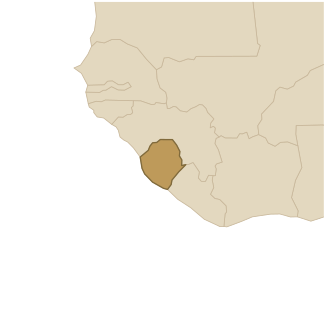
Sierra Leone is a country in West Africa, on the Atlantic coast, whose name, "lion mountains", was given by a Portuguese navigator in the 15th century, struck, it is said, by the roar of thunderstorms over its coastal hills. Nearly nine million people live there, from several peoples (Temne, Mende and others); the capital, Freetown, was founded as a land of freedom for freed slaves. Rich in diamonds and forests, the country has recovered from a civil war.
Geography
Sierra Leone packs strong contrasts into a small country. The Atlantic coast has some of the finest sandy beaches in West Africa, along with estuaries and mangroves, overlooked near Freetown by the lion mountains. Inland the land rises into plateaus and hills covered in rainforest and wooded savanna, a refuge for rare wildlife, including chimpanzees and pygmy hippos on Tiwai Island. The hot, very humid climate has an intense rainy season. The ground holds diamonds, both the country's wealth and its curse.
History
Like its neighbours, this coast was hit by the Atlantic slave trade. But its history took a unique turn in 1787, when British philanthropists founded what would become Freetown, the "free town", to settle freed slaves from England, later from Nova Scotia and Jamaica, joined by Africans freed from slave ships by the British navy after abolition. Out of this mix came the Krio people. A British colony, then independent from 1961, Sierra Leone went through an atrocious civil war in the 1990s, fuelled by "blood diamonds". The country has regained peace and democracy, and came through a terrible Ebola epidemic in 2014–2016.
Languages and faith
The language that unites the country is Krio, a Creole born of English and African languages, spoken by almost all Sierra Leoneans as a common language, alongside the languages of the different peoples: Mende, Temne and others; English remains the official language. Sierra Leone is an example of religious coexistence: Muslims (the majority) and Christians live together peacefully, often within the same families, alongside traditional religions and their initiation societies.
Culture and way of life
Sierra Leonean culture is lively and mixed. There are the traditional initiation societies, with their masks and dances, including the famous sowei mask of the women's Sande society, one of the few sacred masks in the world worn by women. There is the Krio culture of Freetown, its wooden houses with verandas built by the freed settlers, its food and its speech. There is also a busy music scene and a passion for football. Life revolves around rice, the staple without which a meal is not a meal, leaf sauces (plasas) and fish.