El Salvador
The smallest and most densely populated country in Central America, a land of volcanoes and Pacific surf, heir to the Maya and Pipil world.
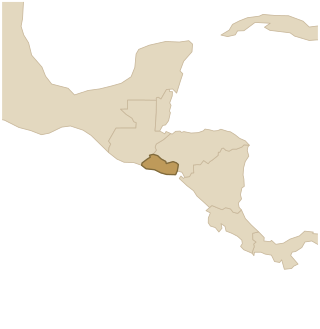
At a glance
El Salvador is the smallest country in Central America, and the only one in the region with a coastline only on the Pacific. About six million people live on this small territory, making it the most densely populated country in mainland America; the capital is San Salvador. It is nicknamed the "land of volcanoes", which dot its landscapes. Shaped by a painful history (civil war, emigration, gang violence), El Salvador carries the heritage of the ancient peoples of Mesoamerica.
Geography
El Salvador is dominated by volcanoes and mountains, which run in a double line across the country, with near-perfect cones such as Izalco, once called the "Lighthouse of the Pacific". Between the ranges lie fertile valleys of rich volcanic soil, plateaus and beautiful crater lakes such as Lake Coatepeque. The Pacific coast has black volcanic beaches and waves well known to surfers. Lying on the Ring of Fire, the country has earthquakes and eruptions, but they have given it very fertile soil, ideal for coffee.
History
Before the conquest, the region was home to the Pipil, a people whose language and culture were close to the Aztecs', and earlier to the Maya, as shown by the site of Joya de Cerén, a village frozen under volcanic ash, the "Pompeii of the Americas" and a World Heritage site. Conquered by the Spanish, the country became independent in 1821. The 20th century was marked by inequality and a bloody civil war (1980–1992), followed by years of gang violence that drove hundreds of thousands of Salvadorans to emigrate. Since 2022, under President Nayib Bukele, a state of exception has broken up the gangs and sent murder rates plunging, at the cost of tens of thousands of arrests and strong criticism over civil liberties.
Language and faith
Salvadorans speak Spanish, in a Central American form marked by voseo and by words from Nahuat, the Pipil language, now nearly extinct but the focus of revival efforts. The country is mostly Christian, divided between a long-standing Catholicism and a fast-growing evangelical Protestantism. Archbishop Óscar Romero, assassinated in 1980 for defending the poor and canonised in 2018, is a major moral figure in the country and across Latin America.
Culture and way of life
Salvadoran culture is above all a popular one. Its emblem is the pupusa, a thick maize flatbread stuffed with cheese, beans or pork, the national dish, eaten at any hour. There are also colourful markets, village crafts such as the naive paintings of La Palma, the Holy Week processions with their carpets of dyed sawdust, patron-saint festivals, and coffee from the volcanic highlands. Life revolves around the family, including the very large part of it that has moved to the United States and remains tied to home.