San Marino
A tiny republic perched on a mountain in the heart of Italy, by tradition the oldest surviving republic in the world, independent for more than seventeen centuries.
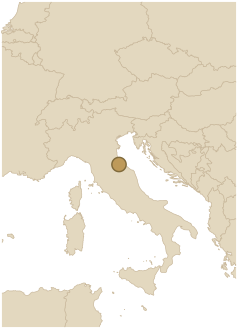
At a glance
San Marino is a tiny republic surrounded by northeastern Italy, gathered around Mount Titano, near the Adriatic coast. By tradition it is the oldest republic still in existence: it dates its founding to the year 301 and has kept its independence almost without a break for more than seventeen centuries. About 34,000 people live there, in a democracy headed by two Captains Regent elected every six months. Prosperous and peaceful, this small state has outlasted the empires and kingdoms around it.
Geography
San Marino is built around Mount Titano, a limestone ridge overlooking the Romagna plain and, in the distance, the Adriatic Sea. Along its crest stand three medieval towers, the Three Towers, the country's symbols, with views over the whole region. Around the old town clinging to the rock lies a gentle landscape of hills, vines, villages and Italian countryside. The climate is Mediterranean, cooled by altitude. From the top of Titano you can take in the whole of this small territory surrounded by Italy at a glance.
History
According to legend, San Marino was founded in 301 by Marinus, a Christian stonemason from Dalmatia fleeing persecution, who took refuge on Mount Titano and started a small community there. From this core grew a free city in the Middle Ages, which kept its independence thanks to its hilltop position, skilful diplomacy and neutrality. The papacy recognised its freedom in 1631. During Italian unification in the 19th century, San Marino, which had sheltered Garibaldi on the run, was allowed to keep its sovereignty. Neutral in modern conflicts, it is now one of the last city-states in Europe.
Language and faith
People in San Marino speak Italian, along with a dialect close to the Romagnol of the neighbouring region. The country is deeply Catholic by tradition, like the Italy that surrounds it, and Christianity is central to its identity, since its founding is credited to a saint. Churches, religious festivals and devotion to Saint Marinus, patron and founder, celebrated every 3 September, the national day, set the rhythm of life in this small community.
Culture and way of life
San Marino's culture is that of central Italy, shaped by centuries of independence and republican pride. There is the medieval heritage of the Three Towers and the walls, a UNESCO World Heritage site, the solemn installation ceremonies of the Captains Regent, costumed festivals and historical re-enactments with crossbowmen and medieval processions. There is an Italian way of life (the piazza, coffee, the evening passeggiata) and the food of Romagna: fresh pasta, piadina (a filled flatbread), torta tre monti (a layered cake inspired by the Three Towers) and wines from the hills.