Somalia
The tip of the Horn of Africa, a land of nomads and poets with the longest coastline on the African mainland, where Africa meets the Indian Ocean world.
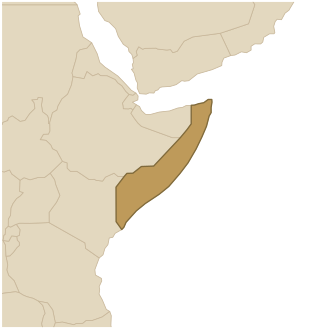
At a glance
Somalia occupies the tip of the Horn of Africa, the promontory that reaches out toward Arabia, between the Indian Ocean and the Gulf of Aden. It has the longest coastline on the African mainland. The great majority of its people are Somalis, who share one language, one religion and a way of life inherited from a long nomadic tradition, though society is still strongly organised by clan. About 19 million people live there; the capital is the old port of Mogadishu.
Geography
Much of the country is dry savanna and semi-desert, where water is scarce and herders move great flocks of camels, goats and sheep with the rains. Somalia has more camels than any other country. The north is mountainous; the flatter centre and south are crossed by the country's only two real rivers, the Juba and the Shabelle, which make farming possible. And everywhere there is the long Indian Ocean coast, which has always looked to trade with Arabia and Asia.
History
The Horn of Africa may have been the ancient land of Punt, the far-off country from which the Egyptians brought back incense and aromatics. Very early, trading towns on the coast such as Zeila and Mogadishu grew rich on Indian Ocean trade and were among the first places outside Arabia to adopt Islam. The Somalis long remained organised in independent clans. Colonised by the British and the Italians, their territories united at independence in 1960. After the fall of Siad Barre's regime in 1991 the state collapsed: the north, Somaliland, declared an independence that no country recognises, and the country is still fighting the jihadist insurgency of al-Shabaab.
Language and faith
Somali is a Cushitic language, related to other languages of the Horn of Africa; it has only been officially written, in the Latin alphabet, since 1972. Somalia is sometimes called the "nation of poets": oral poetry, memorised and recited, is the most prized art, and for a long time it carried history, law and beauty among a people who did not write their language. Somalia is almost entirely Sunni Muslim, and Islam has been part of Somali identity for more than a thousand years.
Culture and way of life
Somali culture is that of a nomadic people, centred on the spoken word, memory and honour. Poetry and song accompany every moment of life, and proverbs and stories pass on the wisdom of the elders. The extended family, the clan, welcoming guests and generosity are core values. At the table people share flatbreads, spiced rice and camel or goat meat, often seasoned with spices from across the Indian Ocean. A very large diaspora keeps this culture alive around the world.