Saint Pierre and Miquelon
A small French archipelago in the North Atlantic, off Newfoundland, the last remnant of New France, a fishing land swept by fog and storms.
At a glance
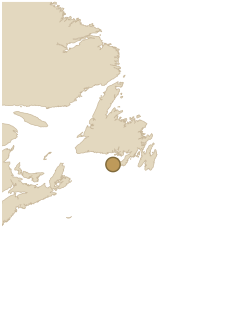
Saint Pierre and Miquelon is a small French archipelago in the North Atlantic, about twenty kilometres off the coast of Newfoundland, in Canada: a piece of France on the doorstep of North America. An overseas collectivity, it is the last remnant of the vast New France. About 5,800 people live there, on Saint-Pierre, the most populated island, and on Miquelon-Langlade. Their ancestors, mostly from Brittany, Normandy and the Basque Country, and from Acadia, were fishermen drawn by the rich waters of the Grand Banks. A land of fog, wind and sea, the archipelago lived for centuries on cod fishing.
Geography
Saint Pierre and Miquelon is an archipelago of harsh, wild landscapes, swept by wind and often wrapped in fog. Saint-Pierre, a small rocky island, holds most of the population around its harbour lined with colourful houses. Miquelon and Langlade, larger and almost empty, are joined by a long sandbar, the isthmus, among bare hills, peat bogs, ponds and long beaches visited by seals. The harsh oceanic climate brings snowy winters and cool summers.
History
Visited from the 16th century by Basque, Breton and Norman fishermen who came for the rich cod banks off Newfoundland, the archipelago became a lasting French possession, the only part of New France left after the loss of Canada in 1763. Fought over by France and England, it was captured, emptied of its people and handed back several times. The great cod fishery kept it alive for centuries. During American Prohibition in the 1920s, Saint-Pierre enjoyed an unexpected golden age as a hub for smuggling alcohol into the United States. After the fisheries declined, the archipelago became a French overseas collectivity.
Language and faith
People speak French, with an accent and expressions inherited from the Breton, Norman, Basque and Acadian origins of the islanders. The archipelago is Catholic by tradition, a faith brought by these people from western France and long central to these seafaring communities, where prayers were said for those who sailed to the banks. Churches, religious festivals and the traditions of the sea carry this heritage.
Culture and way of life
Saint Pierre and Miquelon's culture is French and maritime, inherited from the fishermen of western France and shaped by island life and the closeness of North America. It is a culture of the sea and of cod, of dories (traditional fishing boats) and dory races, of brightly painted wooden houses and of Basque and Acadian folklore that is still alive. Islanders celebrate patron-saint feasts and the Basque festival, with its pelota matches. The cooking is mostly seafood: cod, lobster, scallops, chiard (a local stew) and meat pies.