South Sudan
The world's youngest nation, a land of the Nile and vast wetlands, home to herding peoples with old and proud cultures.
+ Dinka, Nuer, Juba Arabic…
At a glance
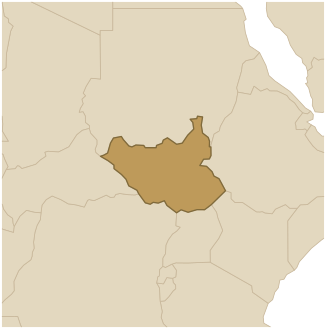
South Sudan is the world's youngest nation: it split from Sudan in 2011 and is the most recent country to win recognition. Landlocked at the heart of Africa, it is crossed by the White Nile. Nearly 12 million people live there, from many peoples, including the great Dinka and Nuer herding peoples; the capital is Juba. Rich in oil but among the poorest countries in the world, and scarred by decades of war, South Sudan is still looking for stability.
Geography
The country is dominated by the White Nile, which crosses it from south to north. At its heart lies the Sudd, one of the largest wetlands in the world: a vast maze of marsh, papyrus and channels where the river spreads out and loses itself. Its wildlife is extraordinary, and the region hosts one of the largest mammal migrations on the planet, that of millions of antelopes. Around it stretch wide savannas and plains, and in the south wooded hills and forests. The climate is hot, with a dry season and a rainy season that swells the marshes.
History
An ancient land of the Nilotic herding peoples, the region was ravaged in the 19th century by slave raids from the north. When Sudan became independent in 1956, the south, African and partly Christian, found itself in a state dominated by the Arab and Muslim north. It rose up in two terrible civil wars which together lasted nearly half a century. After a referendum won with almost 99% of the vote, South Sudan became independent in 2011, amid celebration. From 2013, the rivalry between President Salva Kiir and his vice-president Riek Machar plunged the country into a civil war that killed nearly 400,000 people; the 2018 peace deal remains fragile.
Languages and faith
South Sudan has dozens of languages, including Dinka and Nuer; English was chosen as the official language, and a simplified Arabic, Juba Arabic, serves as a common tongue. The country is mostly Christian, a mark of identity against the Muslim north. Traditional religions, with their sacred bond to cattle, ancestors and spirits, are still very present, often blended with Christianity.
Culture and way of life
South Sudanese culture is that of the great herding peoples, for whom cattle are both wealth and the centre of social, spiritual and poetic life. Among the Dinka and the Nuer, men compose songs for a favourite ox and take its name, and initiation used to involve scarring the forehead. There are leaping dances, bead necklaces and tall draped figures. Life revolves around the herd, sorghum, milk and fish from the Nile.