São Tomé and Príncipe
Two volcanic, forest-covered islands in the middle of the Gulf of Guinea, a Creole land of cocoa and one of the smallest countries in Africa.
+ Forro and Angolar creoles
At a glance
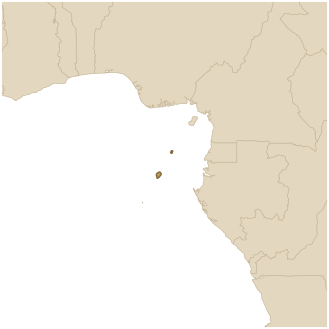
São Tomé and Príncipe is a tiny country of two volcanic islands in the middle of the Gulf of Guinea, on the equator, off Central Africa. It is the second smallest country in Africa, with about 230,000 people; the capital is São Tomé. Like Cape Verde, the islands were uninhabited before the Portuguese arrived, so the São Toméan nation is entirely Creole, born of the mixing of settlers and the Africans brought to work the plantations. Covered in dense tropical vegetation, the archipelago was long a cocoa island.
Geography
Both islands are volcanic: mountains covered in dense, humid rainforest, out of which rise rocky peaks such as Pico Cão Grande, a needle of lava. There are waterfalls, rivers and many endemic species, birds and orchids among them. The coasts are lined with golden or black sand beaches fringed with coconut palms, where turtles come to lay. Príncipe, smaller and even wilder, is a UNESCO biosphere reserve.
History
The Portuguese found the islands empty around 1470 and turned them into one of the very first testing grounds of the slave plantation economy: sugar first, then, in the 19th century, cocoa, of which the archipelago was the world's leading producer in the early 20th century. This wealth rested on the forced labour of Africans brought from the mainland, and after abolition on contract workers held in conditions close to slavery. From the mixing of these captives, the Portuguese and escaped slaves (the Angolares) came the São Toméan Creole people. Independent since 1975, the country adopted multiparty politics in 1991 and has changed governments through elections since then.
Language and faith
The official language is Portuguese, spoken by almost everyone, alongside several local Portuguese-based creoles such as Forro and Angolar. The country is overwhelmingly Catholic, a Portuguese legacy: a living faith marked by patron-saint feasts and often blended with traditions and dances of African origin.
Culture and way of life
São Toméan culture is an equatorial Creole culture, gentle and festive. It is famous for the tchiloli, a danced theatre performed for centuries, which adapts a 16th-century Portuguese tragedy about the Emperor Charlemagne to the islands, with masks and music. There are also the socopé and the ússua, Creole music and dances, crafts, and cooking based on cocoa and fish. Life follows the slow pace of the tropics, the famous "leve-leve" ("easy, easy"), the national motto of taking things slowly. At the table there is fish, plantain, breadfruit, and a local chocolate that is making a comeback.