Suriname
A small forest country on the north coast of South America, the only Dutch-speaking country on the continent and one of the most diverse in the world in its peoples and faiths.
+ Sranan Tongo
At a glance
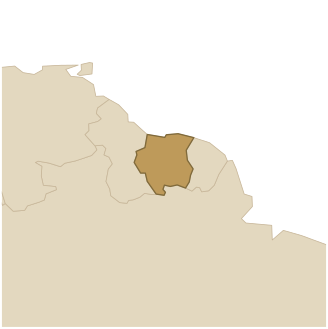
Suriname is a small country on the northeast coast of South America, on the Atlantic, where the continent meets the Caribbean world. It is the only country in South America whose official language is Dutch, a legacy of Dutch colonial rule. Thinly populated, with about 620,000 people, mostly around the capital, Paramaribo, it is one of the most diverse countries in the world: people of Indian descent (Hindustanis), Maroons, Afro-Surinamese Creoles, Javanese, Amerindians and Chinese live side by side, each with their own religion.
Geography
Suriname is the most forested country on the planet by share of land: rainforest covers more than nine-tenths of it, a vast stretch of intact jungle, very rich in wildlife and crossed by great rivers. The people and towns are packed onto the narrow coastal plain, a land of marsh, mangrove and rice fields, where the Dutch built dykes and polders as they did at home. Inland, beyond the rapids, lies the forest, home to Amerindian peoples and Maroons, where most travel is by river.
History
Home to Amerindians, the region passed to the Dutch in 1667: under the Peace of Breda they kept it, while the English kept the future New York. They turned it into a sugar plantation colony built on African slavery. Many enslaved people fled into the forest and founded free societies there, the Maroons, who still keep a deeply African culture unlike any other in the Americas. After abolition in 1863, the Dutch brought in indentured workers from India, then from Java in Indonesia, hence the large Hindustani and Javanese communities. The country became independent in 1975.
Languages and faith
The official language is Dutch, but the everyday language of the street is Sranan Tongo, a creole drawn from English, Dutch and African languages; you also hear Sarnami (a local Hindi), Javanese, and Maroon and Amerindian languages. Religion reflects this diversity: Christianity, Hinduism, Islam (Suriname has one of the highest shares of Muslims in the Americas), and African and Amerindian religions live side by side in peace. In Paramaribo a synagogue and a mosque stand next to each other.
Culture and way of life
Surinamese culture draws on all these peoples. The food is probably among the most mixed anywhere: Indian, Javanese, Creole, Chinese and Amerindian dishes, often on the same street, from roti and nasi to Creole pom. The white wooden historic centre of Paramaribo is a UNESCO World Heritage site. Every community's festivals (Diwali, Holi-Phagwa, Eid, Christmas) are celebrated by everyone, along with kaseko music and the Maroon cultures of the forest, with their drums, cloths and art.