Slovakia
A small country of mountains and castles in the heart of Europe, home to the High Tatras and wooden villages, long united with the Czechs.
At a glance
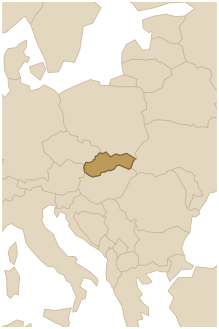
Slovakia is a small landlocked country in Central Europe, between Czechia, Poland, Ukraine, Hungary and Austria. It is a land of mountains and forests, dotted with castles. About 5.4 million people live there; the capital, Bratislava, sits on the Danube some sixty kilometres from Vienna. Long under the Hungarian crown and then united with the Czechs, Slovakia has been an independent state only since 1993.
Geography
Slovakia is Carpathian country: Carpathian mountains cover most of it and peak in the north in the High Tatras, a miniature alpine range of steep summits, glacial lakes and deep forests where bears, wolves and lynx still live. To the south and west the land softens into hills, vineyards and fertile plains along the Danube. The country is also known for its caves and hot springs.
History
In the 9th century the territory was part of Great Moravia, the first great Slavic state of Central Europe, where Saints Cyril and Methodius worked. For nearly a thousand years afterwards Slovakia was part of the kingdom of Hungary, under the Habsburgs from the 16th century: Bratislava, then called Pressburg, was even the capital of Hungary from 1536 to 1783. In 1918 Slovaks and Czechs joined to form Czechoslovakia. After the Second World War, communism and the 1989 "Velvet Revolution", the two peoples separated peacefully in 1993.
Language and faith
Slovak is a West Slavic language, very close to Czech, and speakers of the two still understand each other easily. Slovakia is mostly Catholic by tradition, more observant and more rural than its Czech neighbour, with Protestant and Greek Catholic communities. Faith still shapes village life, its churches and its festivals.
Culture and way of life
Slovak culture belongs to the mountains and the villages. It is the world of the Carpathian shepherds and the fujara, a long, deep-toned shepherd's flute on UNESCO's intangible heritage list; of brightly embroidered costumes, and of folk dances and songs that are still very much alive. There are wooden villages and wooden churches, often built without a single nail, and castles perched on their rocks. The national dish is bryndzové halušky, small potato dumplings with sheep's cheese and bacon.