Slovenia
A small green country between the Alps and the Adriatic, a land of lakes, caves and forests where Germanic, Latin and Slavic Europe meet.
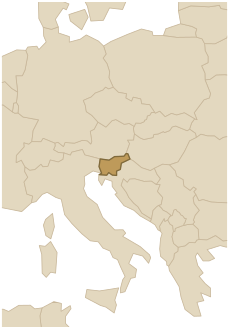
At a glance
Slovenia is a very small country in Central Europe, where the Alps, the Hungarian plain, the Adriatic and the Balkans meet. Just over two million people live there; the capital is Ljubljana. It is one of the most forested countries in Europe, and the scenery changes fast: in a single day you can go from the ski slopes to the sea. Long part of Austria and then of Yugoslavia, Slovenia is now a small, prosperous and peaceful nation.
Geography
In the north rise the Julian Alps and their highest peak, Triglav, above glacial valleys and the famous Lake Bled, with its islet and church. The limestone of the Karst, which gave its name to this kind of landscape, is riddled with large caves, such as Postojna and Škocjan, the latter a UNESCO World Heritage site. In the southwest is a short strip of Adriatic coast with Venetian towns; elsewhere, hills, vineyards and huge forests where bears still live.
History
Settled from the 6th century by Slavs who made their homes in the Alpine valleys, Slovenia spent nearly a thousand years within the Germanic world (the Duchy of Carniola, the Habsburg lands), which tied it to Central Europe rather than to the Balkans. In the 20th century it joined Yugoslavia, where it was the most prosperous republic. In 1991 it was the first to leave, after a war of just ten days, the shortest of the Yugoslav conflicts. Once independent, it joined the European Union in 2004 and the euro in 2007.
Language and faith
Slovene is a South Slavic language, distinct from its neighbours, and unusual in having kept the dual: a special grammatical form for talking about two things or two people, which has almost disappeared elsewhere. The language carried national identity through centuries of foreign rule. Slovenia is mostly Catholic by tradition, a legacy of its long ties to the Austrian world, with fine Baroque churches, though society today is fairly secular.
Culture and way of life
Slovene culture is that of a people attached to nature and a quiet life. It is a country of beekeeping, where the bee is almost a national emblem, with hive fronts painted with folk scenes and well-known honey; it was Slovenia that persuaded the UN to create World Bee Day, on 20 May. The country is proud of its poets, such as France Prešeren, one of whose poems became the national anthem. People go hiking, climbing and cycling, drink wine from the hills, and the cooking mixes Alpine, Mediterranean and Pannonian flavours: potica, a rolled festive cake, is its sweet emblem.