Sweden
A large Nordic country, land of the Vikings, of forests and endless lakes, now known for its peaceful prosperity under the northern lights.
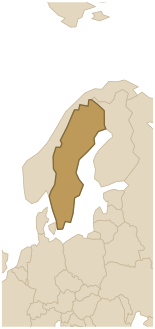
NATO member since 2024
At a glance
Sweden is a large country stretching from north to south along the whole length of Scandinavia. Vast but thinly populated, with 10.5 million people in a huge territory, it is a land of deep forests, nearly a hundred thousand lakes and a long coastline broken into archipelagos. Most Swedes live in the milder south, around the capital, Stockholm, which is built on islands.
Geography
The country unrolls like a long ribbon. In the south are farming plains and indented coasts. Further north, the vast coniferous forest, the taiga, dotted with countless lakes, covers most of the land. A long mountain range marks the border with Norway. And in the far north, beyond the Arctic Circle, lies Lapland, home of the Sami people and their reindeer, where the sun does not set in summer and the northern lights dance in winter.
Peoples and history
Swedish history opens with the Vikings: while those of Denmark and Norway sailed west, the Swedish Vikings, the Varangians, went east along the Russian rivers as far as Byzantium and the Orient, opening trade routes; tradition also credits them with founding the ruling dynasty of Kievan Rus'. Long united with the other Nordic kingdoms, Sweden became an independent kingdom in 1523 and, in the 17th century, a great power that dominated the Baltic. After its last war, in 1814, it chose neutrality and built one of the most advanced welfare states in the world. Russia's invasion of Ukraine led it to join NATO in 2024.
Language and religion
Swedish is a North Germanic language, so close to Danish and Norwegian that these peoples often understand one another; Sami and Finnish are among the recognised minority languages. Swedes are known for speaking excellent English. With the Reformation the country became deeply Lutheran, and the Church remained tied to the state until 2000. Sweden is now one of the most secular societies in the world: religion has become a private matter, though the feasts of the Christian calendar still mark the year.
Culture and way of life
Sweden has given the world a recognisable way of life: clean, functional design, with IKEA as its ambassador, and a taste for simple, well-made things. It is the country of ABBA's pop, of the Nobel Prizes awarded every year in Stockholm (except the Peace Prize, awarded in Oslo), and of two very Swedish ideas: lagom, the art of "just enough", and fika, the coffee-and-bun break. It also has a close bond with nature: swimming in lakes, foraging, and the Midsummer festival around the flower-decked maypole, in the lightest nights of the year.