Eswatini
A small traditional kingdom in Southern Africa, one of the last absolute monarchies in the world, a land of ancestral festivals and wildlife reserves.
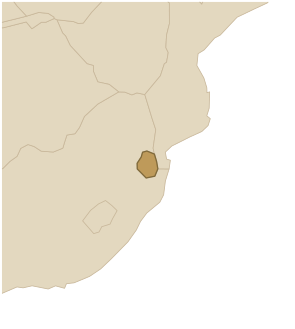
royal capital: Lobamba
At a glance
Eswatini (formerly Swaziland, renamed in 2018) is a very small kingdom in Southern Africa, almost surrounded by South Africa and bordered by Mozambique to the east. A little over a million people live there, nearly all of them Swati, which makes it one of Africa's few nation-states, with a uniform and lively culture. It is one of the last absolute monarchies in the world: the king really does rule. A land of hills, valleys and wildlife reserves, Eswatini keeps its great ancestral festivals alive.
Geography
Despite its small size, Eswatini has a wide range of landscapes, stepping down from west to east. The Highveld in the west is a region of mountains and cool high plateaus with pine forests. The lower Middleveld, with its fertile hills, holds most of the farming and the people. The Lowveld in the east is a hot savanna plain, home to the big reserves where lions, elephants and rhinos live. On the far eastern edge rise the Lubombo Mountains.
History
The Swati kingdom took shape in the 18th century, when a Bantu people under kings of the Dlamini dynasty settled in the region. It held on to its unity and its land through the wars of the time, between the powerful Zulu kingdom and the advancing Boers. Placed under British protection, the kingdom avoided being absorbed into South Africa and became independent in 1968 with its monarchy intact. In 2018 King Mswati III renamed the country Eswatini, "land of the Swatis" in the national language. In 2021, protests calling for democracy were harshly put down.
Language and faith
The country has two official languages: Swati (siSwati), a Bantu language of the Nguni group related to Zulu and spoken by almost everyone, and English. Eswatini is mostly Christian, with many independent African churches that often blend Christian faith with traditional beliefs. Respect for the ancestors and the spirits remains strong, as does the role of the king and the queen mother, who are both political and spiritual figures.
Culture and way of life
Swati culture is one of the liveliest in Southern Africa, famous for its two great national festivals. The Umhlanga, or "reed dance", brings together tens of thousands of young women every year to dance before the queen mother. The Incwala, the first-fruits festival, is the most sacred, celebrating kingship and renewal. There are also beaded and feathered costumes, drums, dances and crafts. Life revolves around maize, livestock and the extended family, and custom and the king are still held in deep respect.