Syria
One of the cradles of civilisation, a land of the Fertile Crescent where people learned to farm and to write, and a crossroads of empires since the dawn of history.
among the oldest cities in the world
At a glance
Syria lies at the heart of the Levant, the eastern shore of the Mediterranean, which from the dawn of history was one of the great centres of human life. Its capital, Damascus, is often cited as the oldest continuously inhabited city in the world, with Aleppo not far behind. At the crossroads of three continents, the country has seen every empire pass through. Since 2011, a civil war has killed hundreds of thousands of people and driven millions of Syrians into exile; Bashar al-Assad's regime fell in December 2024.
Geography
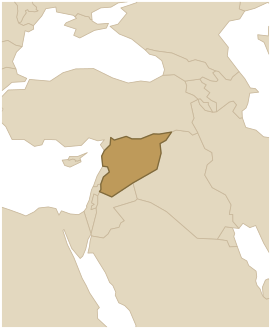
The country reads from west to east. There is a green, gentle Mediterranean coastal strip backed by mountains; then rich farmland around the big cities of Damascus, Homs and Aleppo, and the valley of the Orontes. To the east and south the steppe begins, then the desert, crossed by the Euphrates, one of the two rivers of the Fertile Crescent. In the middle of this desert stand the ruins of Palmyra, the city of Queen Zenobia, partly destroyed by the Islamic State in 2015.
History
Some of the oldest cities in the world flourished here: Ebla, Mari and above all Ugarit, where one of the first alphabets in history was invented. An Aramaean land, then Greek after Alexander, then Roman, Syria was a major centre of early Christianity: it was on the road to Damascus that Saint Paul was converted. After the Arab conquest, Damascus became the capital of the first great Islamic empire, the Umayyad Caliphate, which stretched from Spain to the Indus. Then came the Crusades, the Mamluks, four Ottoman centuries and a French mandate until independence in 1946. The Assad family ruled the country from 1970 to 2024.
Language and religions
Syria speaks Arabic; in a few villages, including Maaloula, Aramaic, the language Jesus spoke, survives, and a large Kurdish minority lives in the northeast. The country has many religious communities: a majority of Sunni Muslims, but also Alawites, Druze, Ismailis, and one of the oldest Christian presences in the world, spread across several Eastern Churches. These communities lived side by side for centuries.
Culture and way of life
Aleppo is known for its cooking, among the finest in the Middle East, for its covered souks and for its olive-oil and laurel soap; Damascus for its courtyard houses and jasmine. Syrian food (mezze, kibbeh, hummus, pastries with honey and pistachio) is meant to be shared. Its crafts are renowned: damascene metalwork, brocades, marquetry. And hospitality is a duty: guests are received with the greatest care.