Turks and Caicos Islands
A British archipelago south of the Bahamas, a flat land of salt and reefs with some of the finest beaches in the world, home to an Afro-Caribbean community with a past of salt-raking and shipwrecks.
on the island of Grand Turk
some forty islands and islets
At a glance
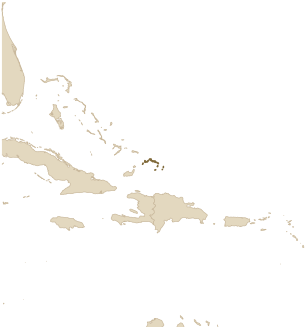
The Turks and Caicos Islands are a British archipelago in the Atlantic, southeast of the Bahamas, continuing the same shallow banks. A British overseas territory, it has two groups of islands, the Turks, where the capital is, and the larger and more populous Caicos: some forty islands and islets, only eight of them inhabited. About 46,000 people live there, mostly on Providenciales; the capital is Cockburn Town. The islanders by birth, known as "Belongers" and mostly Afro-Caribbean, live alongside many foreign residents. Known for its beaches and turquoise sea, the archipelago lives on tourism and offshore finance.
Geography
The Turks and Caicos are low, flat limestone islands with no hills or rivers, covered in scrub, salt ponds and mangroves. They are fringed by a large reef system, which is why their underwater scenery is so striking. Their wealth is the sea: white-sand beaches among the most famous in the world, such as Grace Bay, and turquoise water home to corals and rays, where humpback whales pass in winter. Old salt ponds recall the past. The hot, dry tropical climate leaves the islands exposed to hurricanes.
History
Home to the Taíno Amerindians (Lucayans), whom the Spanish enslaved and carried off from the early 16th century, the islands long stayed empty, visited by pirates. From the 17th century, salt-rakers from Bermuda worked the salt ponds, for a long time the archipelago's main source of wealth. American Loyalists later set up cotton plantations there with enslaved Africans, from whom most of the population descends. After abolition in 1834, the islands lived modestly on salt, fishing and shipwrecks, attached in turn to the Bahamas and to Jamaica. A separate British territory since 1973, they grew fast from the 1980s on tourism and finance; in 2009 London suspended self-government for three years over corruption.
Language and faith
The language of the Turks and Caicos is English, spoken as a Creole close to that of the Bahamas, alongside the Haitian Creole of a large immigrant community. The islands are deeply Christian and churchgoing, with a fervent Protestantism: Baptist, Methodist, Anglican and evangelical churches are everywhere. Religion is central to social life, and Sunday is still kept as a day apart.
Culture and way of life
Turks and Caicos culture is Afro-Caribbean and maritime, inherited from salt-rakers, fishermen and sailors. People play ripsaw (or rake-and-scrape), traditional music made by scraping a saw blade, dance junkanoo, which came from the Bahamas, and sailing regattas mark the year. The traditions of salt, basket-weaving, and conch and lobster fishing are still alive. The cooking centres on seafood: conch, as fritters or salad, fish, spiny lobster, and peas and rice.