Chad
A vast country in the heart of Africa, from the Sahara to the lake that gave it its name, where the Arab and sub-Saharan worlds meet, and where one of humanity's oldest known ancestors was found.
+ local languages
At a glance
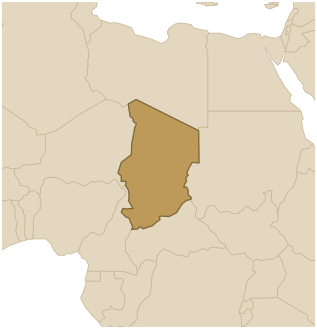
Chad is a huge landlocked country in the heart of Africa, one of the largest on the continent, where the Arab and Saharan world of the north meets sub-Saharan Africa in the south. About 20 million people live there, from more than a hundred peoples; the capital is N'Djamena. The country takes its name from Lake Chad, once an inland sea. It is also in Chad that one of the oldest known ancestors of the human line was found.
Geography
Chad reads from north to south like a gradient of climates. In the north is the Sahara, with the volcanic Tibesti massif, home to the desert's highest peak, and the Ennedi, with its rock arches and gueltas (desert pools). In the centre lies the semi-arid Sahel. In the south is a greener, wetter savanna, where most farming and people are found. In the west lies Lake Chad, once one of the largest lakes in Africa, which has lost most of its surface since the 1960s but is still vital to millions of people.
History
The Chadian desert produced a major discovery: the skull of Toumaï, a hominin about seven million years old, one of the oldest ever found, which makes Chad one of the possible cradles of the human line. In historical times, the lake region was the heart of powerful Sahelian empires, including Kanem-Bornu, which prospered for a thousand years on trans-Saharan trade, and Wadai. Colonised late by France, the country became independent in 1960 and went through decades of conflict, between north and south and with its neighbours. After President Idriss Déby was killed in combat in 2021, his son Mahamat took power and was then elected in 2024; since 2023 the country has taken in more than a million refugees fleeing the war in Sudan.
Languages and faith
More than a hundred languages are spoken in Chad, and the country has two official languages: Arabic, a Chadian form of which serves as a common tongue, and French, inherited from colonial rule. This diversity follows a religious divide: the north and centre are mostly Muslim, a legacy of Saharan trade, while the south is largely Christian and animist. This meeting of religions and traditions has at times caused tension.
Culture and way of life
Chadian culture is that of its many peoples, from the Sahara to the savanna. There are the great horsemen's festivals, where men parade on richly harnessed horses; the Wodaabe and the gerewol, their male beauty contest; and the Toubou of the desert. There are crafts in leather, basketry and silver, and each people's own music and dances. The staple food is millet and sorghum, cooked into a boule (a thick dough ball) and served with sauces, and tea and hospitality are shared.