Togo
A narrow strip of land between the Gulf of Guinea and the savanna, home to many peoples, neighbour and cousin of the birthplace of Vodun.
+ French
At a glance
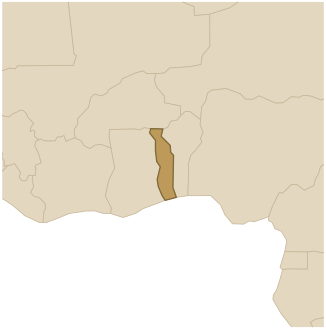
Togo is one of the smallest countries in West Africa: a thin corridor of land stretching some 550 kilometres from the Gulf of Guinea in the south to the northern savannas, and only 50 to 150 kilometres wide. More than nine million people live there, from some forty peoples; the capital, Lomé, is on the coast. A neighbour and cousin of Benin and Ghana, Togo shares the heritage of the great cultures of the Gulf of Guinea, starting with the Ewe people and Vodun.
Geography
Narrow as it is, Togo crosses several landscapes. In the south, a coast of beaches and lagoons faces the Atlantic. Further north, forest and plateaus give way to a range of green hills, the Togo Mountains, with waterfalls and terraced fields. Further still, the land flattens into drier savanna, home to fortified farmsteads and, in the far north, Kéran National Park. In a few hundred kilometres you go from tropical ocean to Sudanian savanna.
History
Before colonisation, the territory was a crossroads of peoples and small kingdoms with no large unified state, and like neighbouring Benin its coast was drawn into the Atlantic slave trade. In 1884 Germany made it a colony, Togoland, which it held up as its "model" colony. After the First World War the territory was split between France and the United Kingdom; the British part later joined Ghana. French Togo became independent in 1960. The Gnassingbé family has ruled it since 1967: Gnassingbé Eyadéma until his death in 2005, then his son Faure, who in 2025, under a new constitution, became President of the Council of Ministers, with no term limit.
Languages and faith
About forty languages are spoken in Togo: Ewe and Mina in the south, Kabiye and others in the north; French, inherited from colonial rule, serves as a common language. The country shares its neighbours' religions: a large Christian population in the south, Islam in the north, and a strong presence of traditional religions, especially Vodun, which honours spirits and ancestors and is often blended with Christianity in the lives of many Togolese.
Culture and way of life
Togolese culture is built on this diversity. There are Vodun ceremonies, and each people's festivals, such as the Evala, the initiation wrestling of young Kabiye men in the north. There is the Akodessewa fetish market in Lomé, along with crafts, bright cloth and music. In the northeast, the earthen tower-houses of the Batammariba, the takienta, which look like small castles, are a UNESCO World Heritage site together with the Koutammakou landscape. At the table: maize paste, yam, fufu and spicy sauces.