Tajikistan
A country of the high Pamir mountains in Central Asia, the region's only Persian-speaking people, a land of peaks, glaciers and ancient Sogdiana.
At a glance
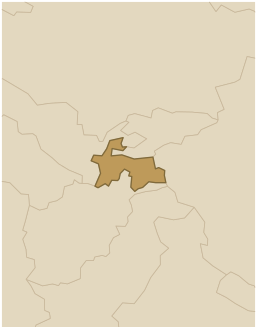
Tajikistan is a landlocked mountain country in Central Asia, between Uzbekistan, Kyrgyzstan, China and Afghanistan. Surrounded by Turkic-speaking neighbours, the Tajiks speak a form of Persian and share much of the culture of Iran and Afghanistan. About 10 million people live there; the capital is Dushanbe. It is the most mountainous country in the region: the peaks of the Pamir, the "roof of the world", cover much of it. The poorest of the former Soviet states, it holds the legacy of the ancient Silk Road cities.
Geography
Mountains cover almost all of Tajikistan, and half the country lies above 3,000 metres. In the east rises the Pamir, a vast range known as the "roof of the world", with peaks over 7,000 metres, huge glaciers (including the Fedchenko, the longest outside the polar regions) and high desert plateaus. Between the ranges lie fertile valleys, such as the Fergana Valley, and turquoise high-altitude lakes. It is a land of peaks, gorges and fast rivers.
History
This land was the heart of ancient Iranian civilisations: Sogdiana and Bactria, whose merchants travelled the Silk Road. Tajiks see themselves as heirs of the Samanid dynasty (9th–10th centuries), which, from Bukhara, led the revival of Persian language and culture: the poet Rudaki, father of Persian poetry, was born in this land. Long divided among emirates, the region was conquered by the Russian Empire and then became a Soviet republic. Independent in 1991, Tajikistan immediately went through a civil war (1992–1997) that killed tens of thousands. Emomali Rahmon has ruled it since 1992.
Language and faith
Tajik is a form of Persian, very close to the Persian of Iran and the Dari of Afghanistan: a Tajik and an Iranian can largely understand each other, which sets the country apart from its Turkic-speaking neighbours. It is now written in the Cyrillic alphabet, and Russian is still widely spoken. Tajikistan is mostly Sunni Muslim, with a large Ismaili community, a branch of Shia Islam, in the high valleys of the Pamir.
Culture and way of life
Tajik culture belongs to the Persian world and to the mountains. Poetry is revered above all: the verses of Rudaki, Hafez and Rumi are recited and sung, and shashmaqam, the classical music of Central Asia, is on UNESCO's intangible heritage list. People celebrate Nowruz, the Persian new year, in spring; they work silk, embroidery and carpets; and the hospitality of the Pamir mountain people is well known. At the table: plov (rice pilaf), bread, green tea and fruit, with the country's apricots and melons especially prized.