Turkmenistan
A country of great desert on the Caspian, in Central Asia, home of Akhal-Teke horses and Silk Road cities, and one of the most closed countries in the world.
At a glance
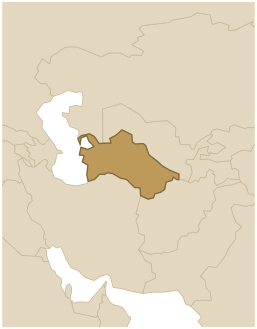
Turkmenistan is a Central Asian country bordered by the Caspian Sea to the west, three-quarters of it covered by the Karakum desert. About seven million people live there according to official figures; the capital, Ashgabat, is a striking city of white marble and gold. Rich in huge reserves of gas, it is also one of the most closed countries on the planet, ruled since independence by regimes with an extreme personality cult; in 2022, Serdar Berdimuhamedow succeeded his father as president. It keeps the heritage of the Turkmen horsemen and the Silk Road cities.
Geography
The Karakum desert, the "black sands", takes up most of the country: a vast arid expanse and one of the largest deserts in Asia. At its heart the Darvaza crater, a pit of burning gas nicknamed the "Gates of Hell", has been alight since 1971. Life is concentrated in the oases, along the Amu Darya river and at the foot of the Kopet Dag mountains in the south. To the west lies the Caspian. Elsewhere there are irrigation canals, cotton fields and the sand-covered remains of ancient caravan cities such as Merv, once one of the largest cities in the world.
History
This land was a great crossroads of the Silk Road: the oasis of Merv, now a UNESCO World Heritage site, was one of the largest cities of the medieval world, a centre of learning and a major caravan stop, until the Mongols wiped it out. The region was the heart of the Seljuk empire. The Turkmen tribes, renowned nomadic horsemen, long held sway there and fiercely resisted the Russian conquest of the 19th century. Absorbed into the USSR, the country became independent in 1991.
Language and faith
Turkmen is a Turkic language, related to Turkish, Azerbaijani and Kazakh, once written in Arabic script and then Cyrillic, and now in the Latin alphabet. Turkmenistan is mostly Sunni Muslim, with an Islam mixed with old tribal customs and reverence for ancestors, and closely controlled by the state. Clan traditions and hospitality remain central values.
Culture and way of life
Turkmen culture belongs to the horsemen and weavers of the desert. The country is proud of the Akhal-Teke horse, one of the oldest breeds in the world, with a golden, metallic coat, and a national emblem. The Turkmen carpet, with deep red geometric patterns handed down through generations, even appears on the flag. There are also fur hats, women's silver jewellery and the music of the bards, the bagşy. At the table: green tea, rice pilaf, bread and melons.