Trinidad and Tobago
Two islands off Venezuela, the birthplace of carnival, steelpan and calypso, and one of the most mixed populations in the world.
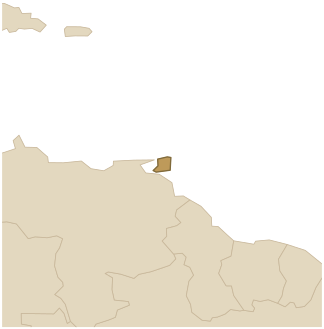
+ Creole
At a glance
Trinidad and Tobago is a country of two islands at the southern end of the Caribbean island arc, about ten kilometres off the coast of Venezuela; geologically, Trinidad is a piece of the mainland. About 1.4 million people live there; the capital is Port of Spain. It is one of the most prosperous countries in the Caribbean, thanks to its oil and gas, and one of the most mixed in the world: people of African, Indian, European, Chinese and Levantine descent live side by side, and this mix gave rise to new kinds of music and a carnival famous worldwide.
Geography
The two islands are quite different. Trinidad, the larger and more populous, is crossed by wooded hills that continue the mountains of Venezuela, and has a unique geological curiosity: Pitch Lake, the largest natural deposit of asphalt in the world. It also has marshes full of birds, including the scarlet ibis, one of the two national birds. Tobago, smaller, quieter and greener, has beaches, coral reefs and a rainforest protected since 1776, one of the oldest forest reserves in the world. The climate is tropical, on the edge of the main hurricane belt.
History
Home to Arawaks and Caribs, the islands were reached by Columbus in 1498. Trinidad stayed Spanish until 1797, Tobago changed hands many times, and Britain eventually made them plantation colonies built on African slavery. After abolition in 1834, planters brought in nearly 150,000 indentured workers from India, until 1917, to cut cane: their descendants now make up more than a third of the population, about as many as those of African descent. Independent since 1962, the country built its prosperity on oil and gas.
Language and faith
The official language is English, but everyday speech is an English-based Creole, with echoes of French, Spanish, Hindi and other languages brought by migrants. Religion reflects this diversity: Christianity (Catholic and Protestant), Hinduism and Islam, the last two brought by the Indian indentured workers, live side by side, and each community's festivals, such as Hindu Diwali, a public holiday, are celebrated by all.
Culture and way of life
Trinidad and Tobago punches far above its weight in culture. Its carnival, a great festival of costume, music and dance, inspired the Caribbean carnivals of London, Toronto and New York. It is the birthplace of the steelpan, the "steel drum" hammered out of oil barrels, often described as the only major acoustic instrument invented in the 20th century. It is the home of calypso and soca, music for partying and for social commentary. The food brings African and Indian traditions together: roti, curry, doubles (spiced chickpeas in fried bread).