Tunisia
The smallest and most Mediterranean country of the Maghreb, land of ancient Carthage, always open to the sea and to trade.
+ French, in everyday use
At a glance
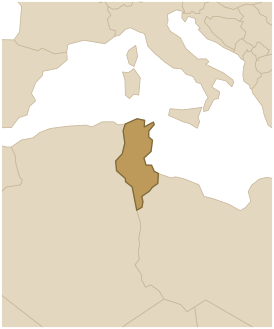
Tunisia is the smallest country of the Maghreb, between Algeria and Libya, but also the one most turned toward the Mediterranean, jutting out toward nearby Sicily. This crossroads position shaped its history: from Carthage to the Arabs, everyone who wanted to control the Mediterranean passed through here. About 12 million people live there; the capital, Tunis, lies next to the ruins of Carthage.
Geography
The country reads from north to south like a gradient. In the north is green, Mediterranean Tunisia, the wettest part, with wooded hills, wheat plains and a long coast of beaches and harbours. In the centre stretch steppes and plateaus covered with olive groves as far as the eye can see. Further south the land dries out: there are the great salt lakes, the chotts, the oases of Tozeur and Douz, and finally the edge of the Sahara and its dunes. In the southeast lies the island of Djerba.
History
This is the land of Carthage, the city founded by the Phoenicians that became the great power of the western Mediterranean and Rome's rival: it was from here that the general Hannibal set out with his elephants to challenge Rome. Rome eventually destroyed it in 146 BC, then made the province of Africa one of its richest granaries, dotted with great cities such as El Djem and its huge amphitheatre. After the Arab conquest, Kairouan became one of the first holy cities of Islam in the Maghreb. Then came the Ottomans, and then the French protectorate. Independent in 1956, Tunisia was modernised by Bourguiba, a pioneer of women's rights; and it was here, in 2011, that the "Arab Spring" began. Since 2021, President Kais Saied has concentrated most power in his own hands.
Peoples, language and faith
Like all of the Maghreb, Tunisia was originally a Berber land, largely Arabised since the Islamic conquest but keeping that old foundation beneath the language and religion that came from the East. People speak Tunisian Arabic, heavily mixed with French, which is itself widely used in education and business. The country is almost entirely Sunni Muslim of the Maliki school, and keeps the memory of old Christian and Jewish communities, including that of Djerba, one of the oldest in the world, which still lives around the Ghriba synagogue.
Culture and way of life
Tunisia has a thoroughly Mediterranean way of life. Its towns are white and blue, like Sidi Bou Said, perched above the sea. Its food, spiced with the famous harissa chilli paste, combines couscous, grilled fish, crisp briks and plenty of olives. Arab-Andalusian music, malouf, sits alongside popular rhythms, and crafts play a big part, from mosaics inherited from Rome to pottery and carpets.