Turkey
The bridge between Europe and Asia, a land where people built some of their very first villages and some of history's greatest empires.
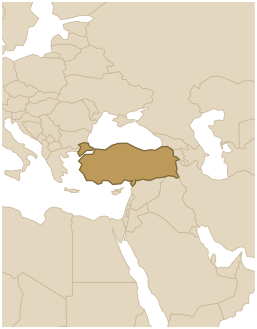
largest city: Istanbul
At a glance
Turkey, officially Türkiye, straddles two continents. Its largest city, Istanbul, spreads across both Europe and Asia, on either side of the Bosphorus. Most of the country is in Asia, though: Anatolia, a vast peninsular plateau bordered by three seas. Some 85 million people live in this country, which was the heart of several of history's greatest empires; the capital is Ankara. Recep Tayyip Erdoğan has led it since 2003.
Geography
The country is built around a high central plateau, dry and continental, ringed by mountains that rise eastward to the sources of the Tigris and Euphrates and to Mount Ararat. The coasts are quite different: mild and Mediterranean in the south and west, planted with olives and citrus, and greener and wetter along the Black Sea in the north. In the centre, Cappadocia raises its strange chimneys of soft rock, hollowed out into villages and churches. It is earthquake country, where tectonic plates meet: the February 2023 earthquake killed more than 50,000 people in the southeast.
History
It was in Anatolia that people built some of the very first villages, nine thousand years ago, and the sanctuary of Göbekli Tepe, six thousand years older than the pyramids. The Hittites ruled here, Troy stood here, the first Christians preached here. In 330, Emperor Constantine made Constantinople the capital of the Eastern Roman Empire, Byzantium, which lasted more than a thousand years. Then the Turks came from Central Asia; in 1453 the Ottomans took the city, and their empire came to dominate three continents. From its ruins, Mustafa Kemal Atatürk built a modern, secular republic in 1923.
Language and religion
Turkish is related neither to the languages of Europe nor to Arabic: it comes from Central Asia, from the Turkic language family. In 1928 Atatürk switched it from Arabic script to the Latin alphabet, a symbol of his modernisation. Kurdish is spoken by a large minority, mostly in the southeast. The country is overwhelmingly Sunni Muslim, with a large Alevi minority, in a state with a secular tradition. Turkey keeps from its past a faith tinged with Sufism: Konya is where the great mystic poet Rumi lived, and where the dervishes whirl.
Culture and way of life
Turkish culture is that of a crossroads, where the East meets the Mediterranean. It is the life of covered bazaars and caravanserais, knotted carpets, hammams and tea served at all hours in small glasses. Its food is among the richest in the world: kebabs and skewers, countless meze, pastries, and sweets such as baklava and Turkish delight. And no guest leaves without being fed.