Tuvalu
One of the smallest and lowest-lying countries in the world, nine Polynesian atolls on the front line of rising seas, a symbol of the fight against climate change.
At a glance
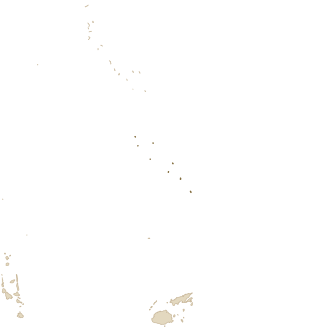
Tuvalu is one of the smallest countries in the world: nine Polynesian atolls strung across the central Pacific, between Australia and Hawaii. About 11,000 people live there; the capital is Funafuti. Its name means "eight standing together", after the eight traditionally inhabited islands. Tuvalu has become, without choosing to, a global symbol: its highest point is under five metres, and it is on the front line of rising seas. In the big international conferences, it speaks for the nations threatened by climate change.
Geography
Tuvalu is made up entirely of coral atolls and islets, so low and narrow that in places only a few dozen metres separate lagoon from ocean. There are no mountains, no rivers, and hardly any land: the country is one of the lowest and smallest in the world. Around it lie turquoise lagoons and reefs. This fragility puts Tuvalu on the front line of rising seas: ever-higher tides, salted soil, shrinking islets. In 2022 the country announced it would build a digital copy of its territory to preserve the nation if the land disappears, and since 2024 a treaty with Australia has offered its people a path to settle there.
History
Settled about a thousand years ago by Polynesian navigators, mostly from Samoa and Tonga, the islands were organised into clan communities. In the 19th century they suffered from passing whalers and from "blackbirding", the kidnapping of islanders for forced labour. Made a British protectorate in 1892 as the "Ellice Islands" and joined to the Gilberts (today's Kiribati), they separated peacefully after a referendum in 1974 and became independent in 1978 as Tuvalu. Since then, the small country has devoted much of its diplomacy to warning the world about global warming.
Language and faith
People speak Tuvaluan, a Polynesian language close to Samoan, alongside English, the official language. Tuvalu is one of the most Christian countries in the world: nearly everyone belongs to the Church of Tuvalu, a Congregationalist church brought by missionaries. The church is the heart of every village, Sunday is sacred, and choral singing matters a great deal. This faith has merged with the traditional values of community, sharing and respect for elders.
Culture and way of life
Tuvaluan culture belongs to a small, deeply communal Polynesian people whose life centres on each island's meeting house, the maneapa. Its most joyful expression is the fatele, a sung dance in which the whole village, seated around a wooden box used as a drum, sings and beats out a rhythm that keeps speeding up. There is also the weaving of pandanus leaves, flower garlands and shell necklaces. Life revolves around the sea, fishing, swamp taro (pulaka), breadfruit and coconut.