Tanzania
The land of Kilimanjaro and the Serengeti, from the cradle of humanity to the spices of Zanzibar, one of the great nations of Swahili East Africa.
largest city: Dar es Salaam
+ ~120 languages
At a glance
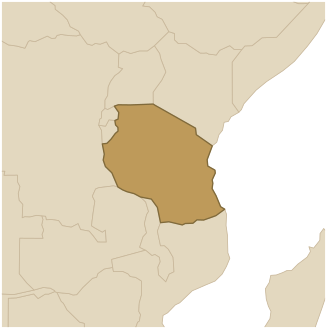
Tanzania stretches across East Africa to the Indian Ocean, around the continent's Great Lakes (Victoria, Tanganyika, Malawi), which mark its borders. It is home to Kilimanjaro, the highest peak in Africa, whose glaciers are shrinking a few degrees from the equator, and to some of the largest wildlife reserves in the world. About 68 million people live there, from more than 120 peoples united by a common language, Swahili. The capital is Dodoma; the largest city is Dar es Salaam.
Geography
In the east lie a tropical coastal plain and the spice islands of Zanzibar. Inland stretch the great savannas of the Serengeti, scene of the largest animal migration on the planet, when millions of wildebeest and zebra cross the plains. Nearby is the Ngorongoro crater, a huge caldera teeming with life. In the north rise Kilimanjaro and Mount Meru, and the Great Rift Valley runs through, with its lakes and volcanoes, including Ol Doinyo Lengai, which erupts a lava found nowhere else.
Peoples and history
It was in the Olduvai Gorge and at Laetoli that some of the oldest fossils of our ancestors were found, along with the oldest known human footprints, three and a half million years old, hence the nickname "cradle of humanity". Much later, on the coast, trade with Arabia and Persia gave rise to the Swahili civilisation and its trading cities, such as Kilwa. Zanzibar became an Omani sultanate and a hub of the spice and slave trades. A German and then British colony, Tanganyika became independent in 1961 and united with Zanzibar in 1964. Its founding father, Julius Nyerere, built it into a united nation. Samia Suluhu Hassan, the first woman president, in power since 2021, was re-elected in 2025 in a vote without real opposition, followed by protests that were harshly put down.
Languages and religion
Tanzania is the great country of Swahili, a Bantu language born on the coast and rich in Arabic words, which the country made the national language of all its peoples, a rare case of linguistic unity on the continent. English is used alongside it. The country is peacefully divided between Christians and Muslims, the latter the majority on the coast and in Zanzibar, and traditional beliefs are still alive among many peoples.
Culture and way of life
Tanzania is known worldwide for its safaris and great parks, but its culture is just as lively: bongo flava, a blend of hip-hop and local rhythms, gets all of East Africa dancing, and tingatinga painting, with its bright colours, is recognisable at a glance. On the coast and in Zanzibar, Swahili culture prevails, with its carved wooden doors and food scented with clove and coconut. Inland, people share ugali, a maize porridge that is the base of every meal.