Uganda
The "pearl of Africa", a green, fertile land of Nile sources and great lakes, refuge of the last mountain gorillas.
+ Luganda and ~40 languages
At a glance
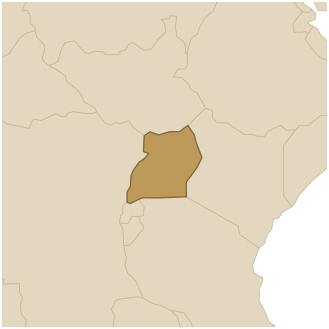
Uganda is a landlocked country in the interior of East Africa, straddling the equator but cooled by altitude, which gives it a mild climate and lush vegetation all year round. This green beauty earned it the nickname "pearl of Africa", made famous by Churchill. It borders a large part of Lake Victoria, the largest lake in Africa, where the Nile begins. About 46 million people live there, one of the youngest populations in the world; the capital is Kampala. The country also hosts more than 1.5 million refugees, more than any other in Africa.
Geography
Uganda is a country of water and hills. Much of its territory is covered by lakes (Victoria, but also Albert, Edward and Kyoga) and by the marshes and rivers that connect them. It is near the town of Jinja that the White Nile leaves Lake Victoria on its long journey north. To the west the country is bordered by the Rwenzori Mountains, the "Mountains of the Moon", with glaciers on the equator, and by forests that hold nearly half of the world's remaining mountain gorillas.
Peoples and history
Before colonisation, the region was home to powerful kingdoms, the most famous of which, Buganda, gave the country its name: ruled by its king, the Kabaka, it had an organisation that impressed the first European travellers. These kingdoms still exist as traditional institutions. Britain made Uganda a protectorate in 1894, until independence in 1962. The country then went through dark years, especially under Idi Amin's dictatorship (1971–1979), before peace returned from 1986 under Yoweri Museveni, who has ruled ever since.
Languages and religion
Uganda has about forty languages. English, inherited from colonial rule, is official alongside Swahili, but the most widely spoken language in daily life, especially in the centre, is Luganda, the language of Buganda. The country is overwhelmingly Christian, Catholic and Protestant, and the 19th-century Ugandan Christian martyrs are deeply revered; a large Muslim minority lives alongside them, mostly in peace.
Culture and way of life
Ugandan culture draws on the traditions of its many peoples: music, dances and royal drums mark the celebrations. The country loves music and, like the rest of the region, football. The staple food is matoke, steamed and mashed plantain, served with groundnut or bean sauce; on the street people eat the rolex, an omelette rolled in a chapati. Uganda is also known for its mountain gorillas, which visitors can approach in the Bwindi forest.