Ukraine
The largest country lying wholly in Europe, a vast plain of black earth and wheat, cradle of the Cossacks and of old Rus'.
millions of refugees abroad since 2022
largest country wholly in Europe
+ Russian, widespread
At a glance
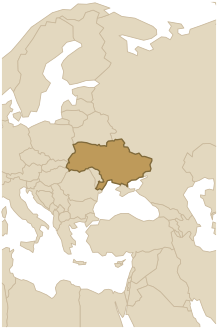
Ukraine is the largest country lying wholly in Europe, on the continent's eastern edge, between Central Europe and Russia. It is above all a country of plains, with the famous "black earth", among the most fertile soils on the planet. Open and without natural barriers, these plains have also let invaders through. It was long called the "breadbasket of Europe". About 38 million people live there; the capital, Kyiv, stands on the Dnieper. Since February 2022 the country has faced a full-scale Russian invasion.
Geography
The country is a vast plateau of plains and gentle hills, covered with fields of wheat, maize and sunflowers as far as the eye can see. These open plains, the steppe, stretch on east toward Asia: this is the route horsemen from deep in the continent have always taken. The great Dnieper river crosses the country from north to south into the Black Sea, whose shore in the south is lined with beaches and ports. Only the Carpathians, in the west, break this expanse with their wooded mountains.
Peoples and history
It was in Kyiv that Rus', the first great East Slavic state, was born in the Middle Ages; it adopted Orthodox Christianity in 988, a founding story claimed by Ukrainians, Russians and Belarusians alike. For centuries these plains were a borderland (the usual reading of the word "Ukraine"), fought over by Poland-Lithuania, Russia and the Ottomans, and guarded by the Cossacks, free horsemen of the steppe who became a national symbol. Under Soviet rule, a man-made famine, the Holodomor, killed millions in 1932–33. The country declared independence in 1991. In 2014 Russia annexed Crimea and backed separatists in the Donbas, then in February 2022 launched a full-scale invasion.
Language and religion
Ukrainian is an East Slavic language, close to Belarusian and related to Russian and Polish, written in the Cyrillic alphabet; Russian is still widely spoken, especially in the east, though many have turned away from it since 2022. The country is mostly Orthodox Christian by tradition, inherited from Kyivan Rus', with a strong Greek Catholic presence in the west. Golden-domed churches, icons and the great religious feasts hold an important place in the country's identity.
Culture and way of life
Ukrainian culture is rich in folk traditions. There is the embroidered shirt, the vyshyvanka, in which every pattern has a meaning, and pysanky, Easter eggs covered in intricate designs. There are choirs and Cossack songs. At the table, borscht, a beetroot soup on UNESCO's intangible heritage list, and varenyky, small filled dumplings, reflect the plenty of a fertile land.