Kosovo
A young landlocked country in the heart of the Balkans, a land of mountains and plains with a very young population, whose history brings together Albanians, Serbs and long centuries of empire.
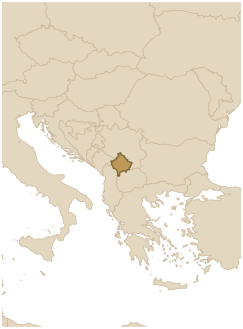
one of the youngest in Europe
At a glance
Kosovo is a small landlocked country in the heart of the Balkans, surrounded by Serbia, North Macedonia, Albania and Montenegro. It is one of the youngest states in the world: it declared independence in 2008, recognised by about a hundred countries but still disputed by others, including Serbia. Its population of about 1.6 million is overwhelmingly Albanian, with a Serbian minority and other communities. It is also one of the youngest populations in Europe; the capital is Pristina.
Geography
Kosovo is a land of mountains and plains. High ranges surround it: to the west and south, the Dinaric Alps and the Šar Mountains, with snowy peaks, deep forests, wild scenery and ski resorts. In the centre lie two large fertile plains, Kosovo and Metohija, the farming and population heart of the country, with cereals, vines and orchards. The continental climate brings hot summers and cold, snowy winters.
History
An ancient land of the Illyrians, possible ancestors of the Albanians, then a province of Rome and Byzantium, Kosovo was a centre of the medieval Serbian kingdom, which explains the Serbs' deep attachment to this land, home to their great monasteries. The Battle of Kosovo, on the Field of Blackbirds in 1389, against the Ottomans, is still a major site of memory. The country then spent several centuries under Ottoman rule, during which the population became mostly Albanian and Muslim. Part of Yugoslavia in the 20th century, Kosovo went through sharp tensions that culminated in the war of 1998–99: massacres and the expulsion of hundreds of thousands of Albanians, then NATO bombing of Serbia. Placed under international administration, it declared independence in 2008.
Language and faith
Kosovo's main language is Albanian, spoken by the great majority, alongside Serbian, the language of the Serbian minority; both are official. Most of the population is Muslim (Sunni) by tradition, a legacy of the Ottoman centuries, while the Serbian minority is Orthodox, and there are also Albanian Catholics. Society is largely secular. Medieval Serbian Orthodox monasteries, a UNESCO World Heritage site, and Ottoman mosques stand side by side on this disputed land.
Culture and way of life
Kosovar culture is deeply Balkan and, for most people, Albanian, shaped by family, tradition and well-known hospitality. There is music with Eastern tones, circle dances (the valle), epic songs, festivals and weddings that can last several days. Social life revolves around the extended family and the café, an institution where young people spend hours. The food combines Turkish, Albanian and Mediterranean influences: flija (layers of batter slow-baked under a lid), byrek (savoury pies), grilled meats and Turkish coffee.