Uruguay
A small, peaceful country between Argentina and Brazil, land of gauchos, beaches and mate, and one of the most stable democracies in Latin America.
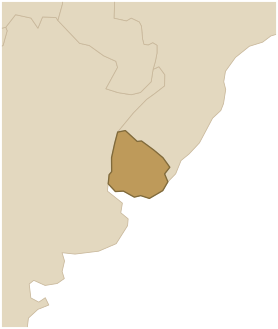
At a glance
Uruguay is a small country in South America, between its two large neighbours, Argentina and Brazil, on the shore of the great Río de la Plata estuary. About 3.5 million people live there, nearly half of them in the greater capital, Montevideo. The country is known for its stability, secularism, welfare state and quality of life, which make it one of the most solid democracies on the continent; it has sometimes been called "the Switzerland of South America".
Geography
Uruguay is a land of wide grassy plains: its countryside is rolling grassland where huge herds of cattle and sheep graze, and livestock far outnumber people. There are no mountains, only gentle hills, the cuchillas. Its other asset is the coast: long sandy beaches on the Atlantic and the Río de la Plata, resorts such as Punta del Este, and lagoons.
History
Home to the Charrúas, hunters of the pampa who were nearly wiped out in the early 19th century, the region was long fought over by the Spanish and Portuguese empires, which founded Montevideo and Colonia there. Independent in 1825 after resisting both its neighbours, Uruguay was built on waves of European immigration, mainly Spanish and Italian. In the early 20th century it was a pioneer of social rights: divorce, the eight-hour day, separation of Church and state, and votes for women, well ahead of most countries. In 2013 it became the first country in the world to legalise cannabis. It also hosted the first football World Cup, in 1930, and won it.
Language and faith
Uruguayans speak Spanish, in a form very close to that of Buenos Aires, sing-song and shaped by Italian immigration, using the informal vos. Uruguay is the most secular country in Latin America: Church and state were separated in 1917, and Christmas is officially called "Family Day". Catholicism is still the largest religion, though not a majority, and plays a far quieter role in public life than elsewhere on the continent.
Culture and way of life
Uruguayan culture shares a lot with Argentina's, with an accent of its own. There is mate, a bitter infusion sipped from a gourd through a bombilla from morning to night, thermos under the arm. There is the gaucho, the horseman of the pampa, and the asado, the big barbecue that brings family and friends together. There is candombe, drumming and dance inherited from Africans and on UNESCO's intangible heritage list, which drives the carnival of Montevideo, the longest in the world; tango, shared with Argentina; and a consuming passion for football.