Uzbekistan
The heart of the Silk Road, land of Samarkand and Bukhara and their blue tilework, in the middle of Asia.
+ Russian
At a glance
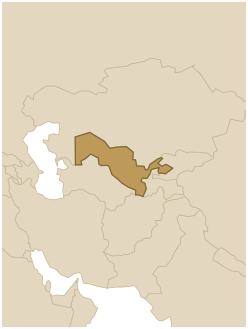
Uzbekistan lies at the heart of Central Asia, between great deserts and high mountains, with no access to the sea: along with Liechtenstein, it is one of only two countries in the world surrounded entirely by other landlocked countries. Yet for centuries this central position made its fortune: Uzbekistan is the historic heart of the Silk Road, the great caravan route between China and Europe, and home to Samarkand and Bukhara. About 37 million people live there; the capital is Tashkent.
Geography
Much of the country is desert or steppe: vast arid expanses cover the centre and west, including the Kyzylkum desert. Life is concentrated where there is water, along two great rivers flowing down from the mountains, the Amu Darya and the Syr Darya, in green oases and fertile valleys such as the Fergana Valley, the garden of Central Asia. In the east rise the foothills of the Pamir and Tian Shan. In the west lies an ecological disaster: the Aral Sea, once vast, almost entirely dried up by Soviet-era irrigation for cotton.
History
This land was the merchants' Sogdiana, a province of the Persian empire later conquered by Alexander. Once Muslim, it had a golden age: from Bukhara and Khwarezm, between the 9th and 11th centuries, came some of the greatest scholars of their time, Al-Biruni, Avicenna and the mathematician Al-Khwarizmi, whose name gave us the word "algorithm". Then came Tamerlane (Timur), the great conqueror, who made Samarkand his capital and filled it with monuments. After centuries of khanates, the region was absorbed by the Russian Empire and then became a Soviet republic. Independent in 1991, it was ruled with an iron hand by Islam Karimov until 2016; his successor, Shavkat Mirziyoyev, has opened the country up.
Languages and faith
Uzbek is a Turkic language, related to Turkish, Kazakh and Turkmen, once written in Arabic script and then Cyrillic, and now moving to the Latin alphabet; Russian is still widely spoken, a Soviet legacy. The country is mostly Sunni Muslim, with an Islam shaped by the great Sufi tradition of Central Asia, of which Bukhara was one of the main centres. Suppressed under Soviet rule, religion has regained its place since independence.
Culture and way of life
Uzbekistan is first of all its architecture: the great squares and madrasas of Samarkand, Bukhara and Khiva, UNESCO World Heritage sites covered in blue tilework with endless interlacing patterns, are among the finest monuments of the Islamic world. Its crafts are renowned: silks, knotted carpets, ceramics, suzani embroidery. Hospitality centres on plov, the national rice pilaf, slow-cooked with meat, carrots and spices and served on every big occasion, and on the round golden bread, non, which is never laid upside down. Tea, music and dance liven up celebrations.