Vatican City
The smallest state in the world, a sacred enclave in the heart of Rome, seat of the pope and centre of the Catholic Church and its 1.4 billion faithful.
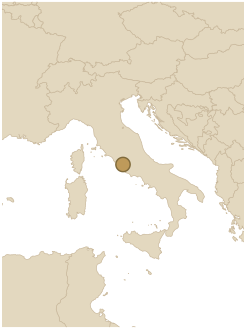
the smallest in the world
the smallest country in the world
At a glance
The Vatican, officially the State of Vatican City, is the smallest sovereign state in the world in both area and population: less than half a square kilometre and a few hundred residents, enclosed in the heart of Rome. It is the seat of the pope and the centre of government of the Catholic Church, which has nearly 1.4 billion members worldwide. Its residents are mostly clergy, members of the Curia and the famous Swiss Guards. Ruled by the pope as absolute sovereign, the Vatican is a tiny state and a global spiritual and diplomatic power. Since May 2025 the pope has been Leo XIV, the first pope born in the United States.
Geography
The Vatican fits entirely on a small hill and its slopes, near the Tiber, enclosed within Rome and surrounded by walls. Almost all of it is taken up by some of the most famous monuments and gardens in the world: St Peter's Basilica and its vast colonnaded square, the Apostolic palaces, the Sistine Chapel, and the gardens, which cover nearly half its area. The whole state is a UNESCO World Heritage site.
History
According to tradition, Vatican Hill is where Saint Peter, the first pope, was martyred and buried, and the basilica was built over his tomb. For more than a thousand years, the popes ruled the Papal States, which covered much of central Italy. These states disappeared with Italian unification, when Rome was taken in 1870, and the pope from then on considered himself a "prisoner" in the Vatican. The issue was settled in 1929 by the Lateran Treaty, which created today's state and recognised the pope's full sovereignty over Vatican City. Since then, this small territory has been the heart of the Church's government.
Language and faith
The everyday language of the Vatican is Italian, but Latin remains the official language of the Holy See and of its solemn documents. Faith is the state's reason for being: the Vatican is the centre of Catholicism and the seat of the pope, the successor of Peter. Its great ceremonies (Christmas and Easter masses, canonisations, jubilees, the Urbi et Orbi blessing) draw huge crowds and are followed around the world.
Culture and way of life
The Vatican holds one of the largest art collections in the world. St Peter's Basilica, a masterpiece of the Renaissance and the Baroque, the Sistine Chapel with Michelangelo's frescoes, the Raphael Rooms and the Vatican Museums bring together centuries of sacred art. It is also a world of age-old rituals and traditions: the Swiss Guards in Renaissance uniform, conclaves and the white smoke announcing a new pope, and papal ceremony.