Saint Vincent and the Grenadines
A volcanic island and a string of islets in the Lesser Antilles, a land of sailing and resistance, and a nation of African and Carib descent.
+ Vincentian Creole
At a glance
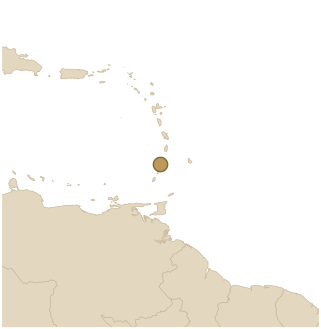
Saint Vincent and the Grenadines is a country in the Lesser Antilles made up of a main island, Saint Vincent, volcanic and green, and a string of some thirty islands and islets, the Grenadines, running south. About 100,000 people live there, mostly of African descent and partly of Carib descent; the capital is Kingstown. The Grenadines, with their anchorages and turquoise water, are a favourite for sailing. Saint Vincent has a long history of resistance, that of the "Black Caribs", who held out against the Europeans for a long time.
Geography
Saint Vincent is volcanic, mountainous and covered in thick rainforest, dominated by the active volcano La Soufrière, whose last eruption, in 2021, forced the evacuation of the whole north of the island. Its coasts have beaches, often of black sand, and farmed valleys. To the south the chain of the Grenadines begins: Bequia, Mustique, Canouan, Union Island and the Tobago Cays, small white-sand islands ringed by clear lagoons and reefs. The tropical climate, eased by the trade winds, puts the archipelago in the path of hurricanes: in 2024 Beryl devastated several of the Grenadines.
History
Saint Vincent was one of the last strongholds of the Kalinago (Caribs). Shipwrecked or escaped Africans mixed with them there to form a new people, the "Black Caribs" or Garifuna, who fiercely resisted the British under their chief Joseph Chatoyer, now a national hero. After their defeat in 1797, the British deported them en masse to the island of Roatán, off Honduras, which is why Garifuna communities live in Central America today. The settlers then expanded the plantations with enslaved Africans, from whom most of the population descends. British until the end, the country became independent in 1979.
Language and faith
The official language is English, but Vincentians speak an English-based Creole day to day. The country is deeply Christian, divided among Anglicans, Methodists and other Protestant churches inherited from the British, as well as Catholics, and faith plays a big part in social life. Traditions of African origin live on, and the memory of the Garifuna remains strong.
Culture and way of life
Vincentian culture is Afro-Caribbean and maritime. Its big event is Vincy Mas, the summer carnival, with parades, soca, calypso and masks. There is also a strong tradition of boat-building and fishing, especially on Bequia, one of the few places in the world where whales are still hunted the old way, under a very small quota. Cricket, inherited from England, is a passion. The food revolves around breadfruit, brought from Tahiti in 1793 by Captain Bligh of Bounty fame, and fried fish, which together make the national dish, along with root vegetables and seafood.