Venezuela
The country of "little Venice", between the Caribbean and the Andes, home of the world's highest waterfall and of Bolívar, the Liberator.
nearly 8 million emigrants since 2014
At a glance
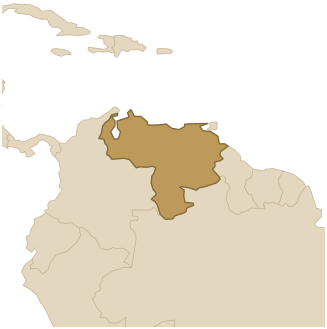
Venezuela occupies the north of South America, facing the Caribbean along a long tropical coast. Its name, "little Venice", comes from the first explorers, who were struck by the stilt villages on Lake Maracaibo. Its landscapes are very varied, from Caribbean beaches to Andean peaks. The country has the largest proven oil reserves in the world, a wealth that made its fortune and then its troubles. About 28 million people live there; the capital is Caracas. It is the homeland of Simón Bolívar, the liberator of South America.
Geography
The country brings together four worlds. In the northwest is a branch of the Andes with snow-capped peaks. Along the sea is a Caribbean coast of beaches and the great Lake Maracaibo, which sits on oil. In the centre lie the llanos, vast grassy plains grazed by the herds of the local cowboys, the llaneros. And in the southeast is the Guiana Highlands, studded with sheer-sided flat-topped mountains, the tepuis, from one of which Angel Falls, the highest waterfall in the world, plunges.
Peoples and history
The coast was home to indigenous peoples, Caribs and Arawaks, when the Spanish landed. Colonisation, then the arrival of enslaved Africans for the plantations, produced a deeply mixed people combining all three origins. Venezuela was the starting point of the continent's great liberation movement: Simón Bolívar, born in Caracas, the "Liberator", led the wars that freed a good half of South America from Spain, dreaming of uniting it into a single nation. In the 20th century, oil made the country for a time one of the richest in Latin America. Since the 2010s, a deep economic and political crisis has driven nearly eight million Venezuelans into exile, the largest exodus in the recent history of the Americas.
Language and religion
Venezuelans speak Spanish, in a fast Caribbean form, alongside dozens of indigenous languages still spoken in remote parts of the Amazon and the Guiana Highlands. The country is overwhelmingly Catholic by tradition, a faith brought by Spain and very present in popular festivals, with a growing evangelical presence and special devotion to some popular saints, such as the doctor José Gregorio Hernández, canonised in 2025.
Culture and way of life
Venezuelan culture is joyful and musical. Joropo, the music of the llanos, with harp, maracas and the small four-stringed cuatro, is its emblem. The country is also proud of El Sistema, its network of youth orchestras, which has trained hundreds of thousands of children, many from poor backgrounds, and produced conductors such as Gustavo Dudamel. Venezuela loves baseball and beauty pageants. At the table, people share the arepa, a maize cake filled in endless ways and a national emblem, and the hallacas of the Christmas season.