British Virgin Islands
A British archipelago in the Lesser Antilles, with dozens of islands and islets famous for sailing, an Afro-Caribbean land that has become a major offshore financial centre.
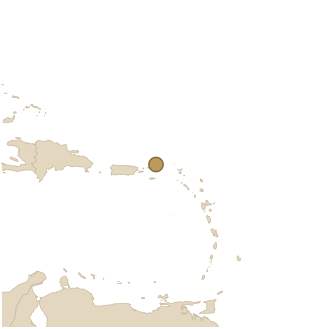
some sixty islands and islets
At a glance
The British Virgin Islands are a British archipelago in the Lesser Antilles, east of Puerto Rico, made up of some sixty islands and islets, only a few of them inhabited: Tortola, the main one, Virgin Gorda, Anegada and Jost Van Dyke. A British overseas territory, they have about 30,000 people; the capital, Road Town, is on Tortola. Most of the population is Afro-Caribbean, descended from those enslaved on the old plantations. Famous for sailing, with calm waters and sheltered anchorages, the islands have also become one of the world's major offshore financial centres.
Geography
Most of the British Virgin Islands are volcanic, with steep green hills ringed by beaches and coves; the exception is Anegada, which is flat coral. Scattered across a deep blue sea, they enclose channels and sheltered bays that sailors love. Virgin Gorda has the famous Baths, a jumble of giant granite boulders forming pools and caves at the water's edge. The tropical climate leaves the islands exposed to hurricanes: Irma devastated them in 2017.
History
Home to Arawak and then Kalinago Amerindians, the islands were named by Christopher Columbus in 1493 after Saint Ursula and her "eleven thousand virgins". A haunt of buccaneers, first settled by the Dutch, they passed to the British in 1672. Sugar cane and cotton plantations were built on the labour of enslaved Africans, from whom most of today's population descends. Abolition in 1834 ended this system. Long poor and thinly populated, the islands grew rapidly in the 20th century thanks to sailing tourism and above all offshore finance. In 2022 the arrest of their premier in the United States on drug-trafficking charges shook the territory.
Language and faith
The language of the British Virgin Islands is English, spoken as a Creole with Caribbean inflections, alongside the languages of an increasingly international population. The islands are deeply Christian and churchgoing, with a fervent Protestantism: Methodist, Anglican and various evangelical churches are everywhere. Religion is central to social life, and Sunday is still kept as a day apart.
Culture and way of life
British Virgin Islands culture is Afro-Caribbean and maritime. There is fungi, traditional music played on homemade instruments (gourd, pipe, banjo), calypso and soca, and the big Emancipation festival, which celebrates the end of slavery every summer. There is a passion for sailing and regattas, and the beach bars of Jost Van Dyke, said to be the birthplace of the painkiller, a rum cocktail. The food features the sea and the land: fish and conch, fungi (a cornmeal dish), Anegada lobster and rum.