United States Virgin Islands
A Lesser Antilles archipelago bought by the United States from Denmark, an Afro-Caribbean land with a past of Danish plantations, its beaches, forts and Creole culture.
on the island of Saint Thomas
three main islands
+ Creole
At a glance
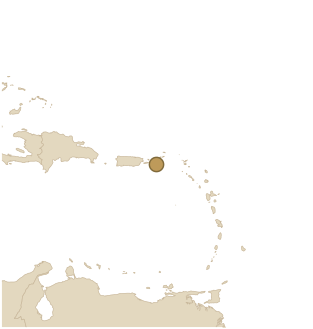
The United States Virgin Islands are an archipelago in the Lesser Antilles, east of Puerto Rico: an unincorporated territory of the United States whose people are American citizens. There are three main islands, Saint Thomas, where the capital is, Saint Croix and Saint John, mostly national park, plus islets. About 87,000 people live there. The islands were Danish for a long time, until the United States bought them from Denmark in 1917 for strategic reasons. Most of the population is Afro-Caribbean, descended from those enslaved on the plantations.
Geography
The US Virgin Islands are volcanic, with steep green hills fringed by some of the best-known beaches in the Caribbean. Saint Thomas, the busiest, is built around the amphitheatre-shaped harbour of Charlotte Amalie. Saint John, the smallest and wildest, is about three-fifths national park, with forests, trails and bays such as Trunk Bay. Saint Croix, larger and flatter, keeps the remains of its sugar past and its colourful colonial towns. The tropical climate exposes the islands to hurricanes: Irma and Maria struck them back to back in 2017.
History
Home to Arawak and then Kalinago Amerindians, the islands were, unusually for the Caribbean, colonised by Denmark from 1672. The Danish West India Company built large sugar plantations there, worked by great numbers of enslaved Africans, from whom most of the population descends; Charlotte Amalie became a major free port. After a slave revolt on Saint Croix, Denmark abolished slavery in 1848. In 1917, in the middle of the First World War, the United States bought the islands to guard the approaches to the Panama Canal; the islanders received American citizenship in 1927 while keeping a strong Creole identity.
Language and faith
The language of the US Virgin Islands is English, spoken as a local Creole, alongside the Spanish of a large community from Puerto Rico and elsewhere. The islands are deeply Christian and churchgoing, with many denominations: Lutheran (a Danish legacy), Methodist, Baptist, Catholic and numerous evangelical churches. Religion plays an important part in social life.
Culture and way of life
US Virgin Islands culture is Afro-Caribbean, mixed with Danish and American heritage. There is quelbe, traditional music played on homemade instruments, calypso, soca and reggae, and the big carnivals of Saint Thomas and Saint Croix, the high points of the year. There are colonial towns with colourful façades, Danish forts, the quadrille dance and crafts. The Creole food features the sea and the land: fungi (a cornmeal dish) with fish, kallaloo, conch, pâtés (spiced pastries) and rum.