Vietnam
A long strip of land along the South China Sea, a country of rice paddies and deltas that has spent its history defending its identity against larger powers.
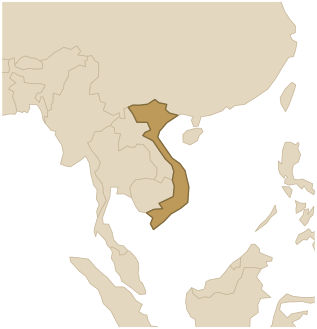
largest city: Ho Chi Minh City
At a glance
Vietnam is shaped like a long S, stretching more than 1,600 kilometres from north to south between the western mountains and the South China Sea. It is often compared to a carrying pole, the shoulder stick with a basket of rice at each end: the country's two great fertile deltas, the Red River delta in the north around Hanoi and the Mekong delta in the south around Ho Chi Minh City. About 100 million people live there, many of them by the water and the rice paddies.
Geography
In Vietnam everything revolves around water and rice. There is a long, indented coast lined with beaches and bays dotted with limestone pillars, such as famous Ha Long Bay; inland, forested mountains home to many minority peoples; and above all the two deltas, a grid of bright green flooded paddies where rice is planted out by hand, bent over in the mud. The tropical monsoon climate often allows two or three harvests a year.
Peoples and history
For nearly a thousand years the north of the country was a province of China, from which it took its writing, Confucianism and administration, but it never stopped trying to break free, and finally did in 938. Centuries of Vietnamese dynasties followed, along with a slow "march to the south" that gave the country its elongated shape. Then came French colonial rule, Indochina, and the 20th-century wars against France and then the United States, among the deadliest of the era, which ended in 1975 with the country reunified under communist rule. Since the economic opening of 1986, Đổi mới, Vietnam has become one of the fastest-growing economies in the world.
Language and beliefs
Vietnamese is a tonal language: the same word changes meaning depending on the pitch it is spoken on. Unusually for mainland Asia, it is written in the Latin alphabet, devised by missionaries in the 17th century. As for beliefs, most Vietnamese easily combine Buddhism, Confucianism and Taoism from China with a very old practice of ancestor worship: almost every home has a small altar to the family's dead. A minority is Catholic, a legacy of the French period.
Culture and way of life
Vietnamese culture is delicate and fresh. Its food, among the most loved in the world, is about balance and fresh herbs: phở, the fragrant noodle soup, spring rolls, iced coffee with condensed milk. It is also the land of the áo dài, a long, elegant split tunic, of the floating markets of the Mekong, of conical hats in the paddies, and of water puppet theatre, an art born in the flooded villages of the Red River delta.