Samoa
An archipelago in the heart of Polynesia, a cradle of Polynesian culture where fa'a Samoa, the traditional way of the ancestors, is still handed down.
At a glance
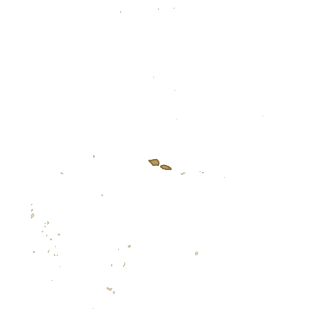
Samoa is an archipelago in the South Pacific, in the heart of Polynesia, made up of two large volcanic islands and a few small ones. About 220,000 people live there; the capital is Apia. Samoa is seen as one of the cradles of Polynesian culture: navigators from this region went on to settle the vast Polynesian triangle, as far as Hawaii, New Zealand and Easter Island. The country holds to fa'a Samoa, "the Samoan way", a traditional way of life based on the clan, the land and respect.
Geography
Samoa is made of lush volcanic islands, with mountains covered in dense rainforest, cut by waterfalls and deep blue pools such as the famous To Sua. All around are turquoise lagoons, coral reefs and palm-fringed beaches lined with villages of open-sided houses, the fale. The hot, humid tropical climate leaves the archipelago exposed to cyclones. Since the country skipped a day at the end of 2011 to move to the other side of the International Date Line, it has been one of the first in the world to see the sun rise.
History
Settled about three thousand years ago by Austronesian navigators of the Lapita culture, Samoa became one of the great centres of the Polynesian expansion across the Pacific. Long organised into rival chiefdoms, the archipelago became, at the end of the 19th century, a prize contested by Germany, the United States and Britain, which partitioned it in 1899: the west became German, then was run by New Zealand from 1914, and the east American (American Samoa, which it still is). The writer Robert Louis Stevenson spent his last years there. In 1962 Western Samoa became the first Polynesian country to regain its independence. In 2021 Fiamē Naomi Mata'afa became the first woman to lead its government.
Language and faith
People speak Samoan, one of the most widely spoken Polynesian languages, alongside English. Samoa is a deeply Christian country: its Constitution calls it "founded on God", and since 2017 it has declared it a Christian nation. The faith brought by missionaries in the 19th century has become central: Sunday, a day of rest and worship, evening prayer in the villages and churches everywhere shape daily life. It has merged with fa'a Samoa and with respect for ancestors and chiefs.
Culture and way of life
Samoan culture, fa'a Samoa, is one of the best preserved in the Pacific. It rests on the family clan (the aiga), customary land, and the system of chiefs, the matai, who run the villages. There is the art of traditional tattooing, the pe'a, a painful full tattoo covering men's bodies from waist to knees; the word "tattoo" itself comes from the Polynesian tatau. There are dances (the siva), songs, the ava (kava) ceremony, and food cooked in a stone oven, the umu: taro, fish, pig, coconut milk.