Yemen
The "Arabia Felix" of the ancients, a green, mountainous land in the south of the peninsula, home of the Queen of Sheba, of incense and of coffee.
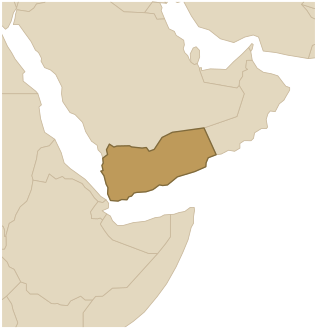
At a glance
Yemen occupies the southwestern tip of the Arabian peninsula, where the Red Sea meets the Indian Ocean, facing the Horn of Africa across the narrow Bab-el-Mandeb strait. Unlike the deserts around it, it is a country of mountains watered by the monsoon, green and fertile enough for the ancients to call it "Arabia Felix", happy Arabia. About 40 million people live there; the historic capital is Sana'a. Since 2014, a war between the Houthi rebels, who hold the north, and the government backed by a Saudi-led coalition has caused one of the worst humanitarian crises in the world.
Geography
Yemen rises from the sea to high mountains, some over 3,600 metres: the highest in all of Arabia. On their slopes, people have carved terraces for thousands of years to farm, catching the monsoon rains. Inland, the land dries out into the great deserts of Arabia. Far out in the Indian Ocean, the island of Socotra, a UNESCO World Heritage site, has a unique flora, including "dragon's blood" trees found nowhere else.
History
Ancient Yemen was rich and powerful. According to tradition, the Queen of Sheba reigned here, and kingdoms flourished that built dams and temples, such as the great dam of Marib. This wealth came from incense and myrrh, precious resins of southern Arabia and the Horn of Africa that caravans carried to temples across the ancient world. The country adopted Islam very early. Later it gave the world another treasure: coffee, whose beans were shipped from the port of Mocha, hence the word "mocha". Long divided between north and south, Yemen was unified in 1990.
Language and faith
Yemenis speak Arabic, in dialects known to be very conservative; on Socotra and in the far east, South Arabian languages also survive, distant relatives of the language of Sheba. The country is almost entirely Muslim, divided between Sunnis of the Shafi'i school and a large Zaydi community, a branch of Shia Islam rooted in the northern mountains. Faith and tribal traditions, with their codes of honour and hospitality, shape a society of mountain people proud of their independence.
Culture and way of life
Yemen has a stunning architectural heritage. The old city of Sana'a, inhabited for more than two thousand years and a World Heritage site, has multi-storey tower houses decorated with white plaster lacework and coloured glass. Further east, Shibam and its centuries-old mud-brick towers form the "Manhattan of the desert". Yemeni culture also means sung poetry, dances to the beat of the drum, and the jambiya, the curved dagger worn at the belt as a mark of honour.