Zambia
Country of the great Zambezi and Victoria Falls, a land of copper and savanna, the peaceful heart of Southern Africa.
+ English
At a glance
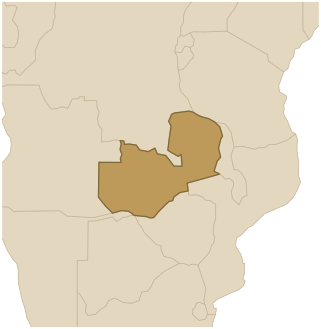
Zambia is a vast landlocked country in Southern Africa, set on a high plateau in the heart of the continent. It is named after the great Zambezi river, which crosses it and, on its border, forms Victoria Falls. Some 20 million people live there, from more than seventy peoples; the capital is Lusaka. With some of the largest copper deposits in the world, and covered in savanna and wildlife parks, Zambia is known for its stability in a long-troubled region.
Geography
The country spreads over a broad plateau where altitude tempers the heat. On the border with Zimbabwe lie Victoria Falls: along almost two kilometres, the Zambezi drops into a gorge in a colossal curtain of water that local people call Mosi-oa-Tunya, "the smoke that thunders". Elsewhere, Zambia has vast savannas, rivers rich in fish, wetlands full of birds and great parks such as South Luangwa, among the richest in Africa for elephants, lions and leopards.
History
Settled during the first millennium by Bantu migrations, the region saw several kingdoms emerge, such as that of the Lozi on the Zambezi floodplains. In the 19th century the explorer David Livingstone crossed these lands and named the great falls after Queen Victoria. Colonised by Britain as Northern Rhodesia and mined for its copper, Zambia gained independence peacefully in 1964. Under its first president, Kenneth Kaunda, it made the unity of its many peoples ("One Zambia, One Nation") a founding principle, and stayed at peace while war raged across Southern Africa. Power changes hands at the ballot box, most recently in 2021.
Languages and faith
Zambia has more than seventy languages, nearly all of them Bantu, with Bemba, Nyanja, Tonga and Lozi the most widely spoken; English, inherited from colonial rule, serves as a common language. The country is overwhelmingly Christian, and its Constitution even declares it a Christian nation; this lively faith mixes in places with respect for ancestors and traditions. Great customary ceremonies still mark the year.
Culture and way of life
Zambian culture comes alive in the great traditional ceremonies that bring the peoples together each year, the best known being the Kuomboka: when the Zambezi floods, the Lozi king leaves his palace on the plains for higher ground aboard a royal barge, to the sound of drums and paddles. It is also the home of the makishi masquerade, on UNESCO's intangible heritage list, and of dance and carving. Life revolves around nshima, the thick maize porridge served with relishes, fish and vegetables, and a strong sense of community.