Zimbabwe
The country named after its "houses of stone", land of Victoria Falls and of a great vanished kingdom, in the heart of Southern Africa.
+ English
the gold-backed ZiG, since 2024
At a glance
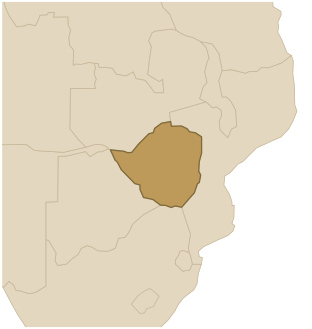
Zimbabwe is a landlocked country in Southern Africa, set on a high plateau between the Zambezi to the north and the Limpopo to the south. Its name means "houses of stone", after the great ruins of an ancient kingdom. About 15 million people live there, mostly Shona; the capital is Harare. It is a land with a mild climate, rich in minerals and wildlife, whose recent history has been hard.
Geography
The country spreads over a vast high plateau, the highveld, with mild temperatures despite its tropical latitude. In the northwest, on the Zambezi, thunder the Victoria Falls, a huge curtain of water that local people call "the smoke that thunders". The country has great savanna parks with elephants, lions and rhinos, such as Hwange. To the south and east, the land drops into hot valleys and rises into green mountains along the border with Mozambique.
History
From the 11th to the 15th century, one of the greatest states of sub-Saharan Africa rose here, Great Zimbabwe: a city with stone walls built without mortar, capital of a prosperous kingdom that traded gold and ivory as far as the Indian Ocean coast, and whose ruins are a UNESCO World Heritage site. Later came the Ndebele kingdom, then British colonisation, which turned the country into Rhodesia, where the white minority declared independence on its own in 1965. After a long liberation war, Zimbabwe became independent in 1980. Then came the Gukurahundi massacres in Matabeleland in the 1980s and, under the long rule of Robert Mugabe, overthrown in 2017, a brutal land reform and an economic crisis with record hyperinflation.
Languages and faith
The most widely spoken language is Shona, the Bantu language of the majority, alongside Ndebele, a relative of Zulu, in the west; English, inherited from colonial rule, remains the language of government, and the Constitution recognises sixteen official languages. Zimbabwe is overwhelmingly Christian, often with a faith mixed with traditional African beliefs: respect for ancestors and for the guardian spirits of the land still matters a great deal.
Culture and way of life
Zimbabwe is famous for its stone sculpture: its artists carve figures in serpentine that are admired around the world. It is also the home of the mbira, a thumb piano with bell-like notes, on UNESCO's intangible heritage list, a sacred instrument that has accompanied ceremonies calling on the ancestors for centuries. Daily life revolves around sadza, the thick maize porridge served with meat and vegetables, the extended family and a strong sense of community, unhu, known in other languages as ubuntu.